


Executive Summary
Independent External Asset Managers (EAMs) in Switzerland face a structural onboarding problem: KYC processes that are formally compliant but operationally expensive, slow, and fragile under audit.
This article examines whether that problem truly exists, where the cost and risk accumulate before any AUM is onboarded, and why many EAMs are quietly searching for a more “client-portal-like” onboarding experience, without lowering compliance standards under FinIA.
The conclusion is not that technology should replace regulation, but that poorly designed onboarding workflows expose firms to avoidable cost, client drop-off, and audit weakness long before they generate revenue.
The hidden cost of KYC friction before AUM exists
For many SME EAMs and independent portfolio managers, onboarding still begins with a familiar sequence: passport copies, proof of address PDFs, wet signatures, follow-up emails, and manual checks. On paper, the process satisfies AML and FinIA expectations. In practice, it creates cost before any mandate produces AUM.
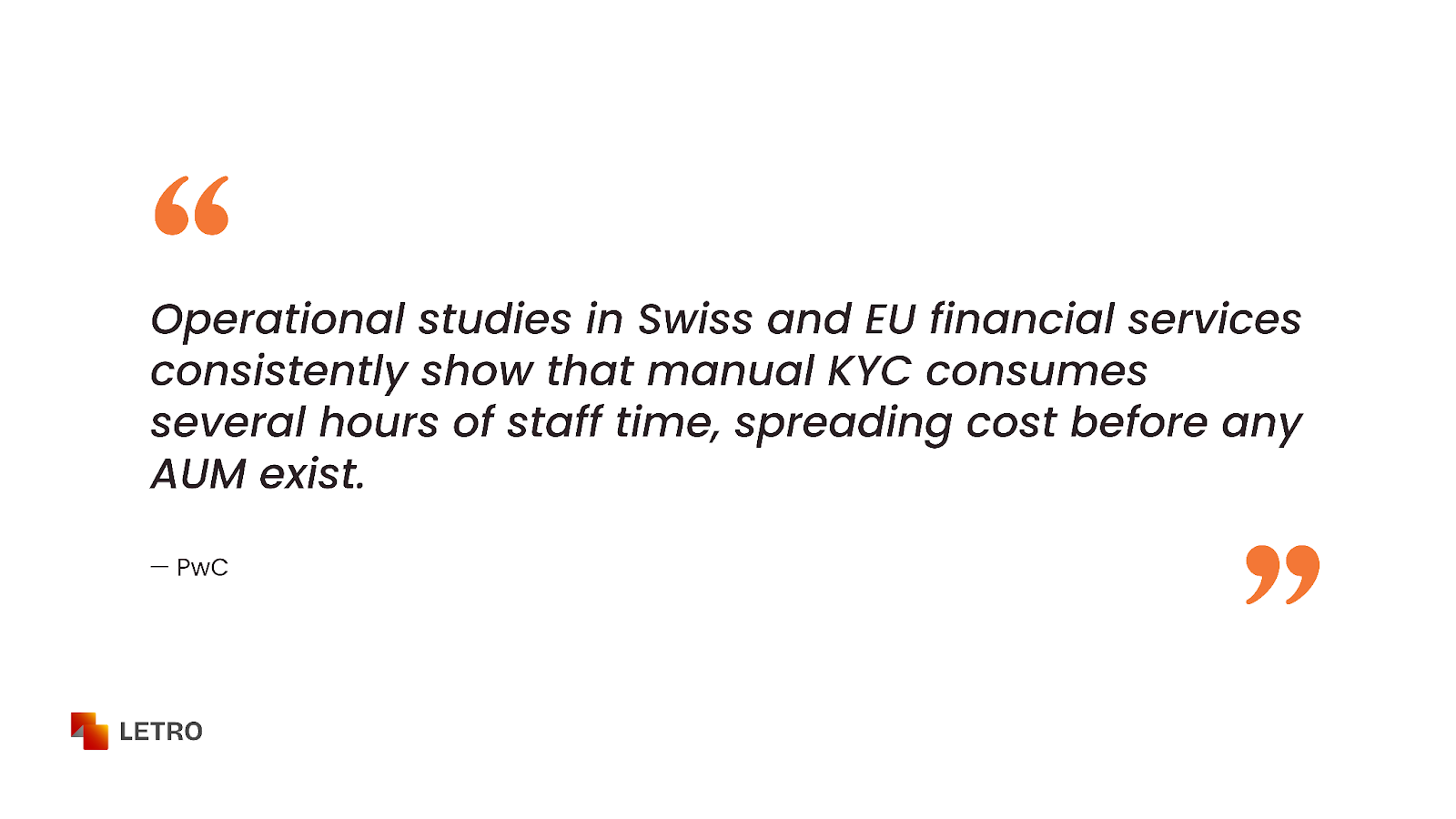
Operational studies in Swiss and EU financial services consistently show that manual, document-driven onboarding consumes several hours of staff time per client, often spread across compliance, relationship managers, and operations. PwC and Deloitte both estimate that onboarding costs scale linearly with client volume, while risk coverage does not improve proportionally. The result is predictable: higher fixed cost per client, longer time-to-mandate, and increased abandonment during onboarding.
This matters because onboarding friction is front-loaded. The firm absorbs the cost before it earns management fees. Every stalled or abandoned onboarding is pure loss.
FinIA compliance is evidence-based, not paper-based
A persistent misconception among smaller EAMs is that compliance is synonymous with document collection. FinIA, aligned with Swiss AMLA and FINMA guidance, does not mandate paper workflows. It mandates evidence.
Regulators expect firms to demonstrate that identity was verified, checks were performed, and decisions were recorded according to risk profile. The medium, paper, PDF, or digital, is secondary to the audit trail. What matters is whether the firm can reconstruct who verified whom, when, under which policy, and with what result.
From a risk perspective, scanned passports stored in shared folders are not inherently safer than digital verification. In fact, they often weaken auditability. Files are duplicated, renamed, emailed, and stored without immutable timestamps or access logs. During an audit, firms struggle to prove integrity and chronology, even though the original intent was compliance.
This is not a theoretical risk. Enforcement actions across Europe repeatedly cite poor documentation trails and unverifiable onboarding steps, not lack of paper, as control failures.
Why onboarding breaks client trust before the relationship begins
EAMs compete on trust, discretion, and professionalism. Yet onboarding is often the first operational interaction a private client experiences. When that interaction consists of unsecured email exchanges, repeated document requests, and unclear status updates, it quietly erodes confidence.
Private clients increasingly expect a secure, structured “client portal” feel, even when the relationship is highly personal. This expectation is not about convenience; it is about signaling seriousness. A fragmented onboarding process sends the opposite signal: that controls are improvised, and information handling is informal.
Empirical data from client-facing financial services shows that unclear onboarding steps and repeated follow-ups materially increase drop-off rates. Each drop-off represents not just lost AUM, but reputational leakage in a referral-driven market.
Audit trail strength is a risk-mitigation tool, not an IT feature
For risk-averse managers, the real question is not whether onboarding is “modern,” but whether it holds up under scrutiny. A defensible onboarding process produces a clear, time-stamped, tamper-evident audit trail.
Weak audit trails do not usually fail on day one. They fail months or years later, during regulatory reviews, disputes, or client complaints. At that point, reconstructing events from emails and file folders becomes expensive and uncertain.
This is where many EAMs begin to reassess their onboarding approach. Not because regulators demand new tools, but because the cost of defending old workflows is rising. Each additional client multiplies the exposure.
The emerging gap: compliant onboarding that clients actually complete
A pattern is emerging among independent EAMs: compliance is formally satisfied, but clients disengage before completion. This gap is subtle but costly.
Clients abandon onboarding not because of KYC itself, but because the process feels opaque and repetitive. They do not know what remains, who has access to their data, or when onboarding will end. For firms, this translates into wasted compliance effort and stalled AUM growth.
The hypothesis worth testing is whether EAMs need onboarding that feels like a secure client portal, structured, finite, and verifiable, while preserving full compliance under FinIA. Early evidence suggests that when onboarding steps are clearly bounded, securely delivered, and transparently recorded, completion rates improve and internal follow-ups drop.
Reducing KYC friction without lowering standards
Reducing KYC friction does not mean relaxing controls. It means removing unnecessary manual handling while strengthening evidence.
Digitally structured onboarding allows firms to verify identity, collect declarations, and record approvals in a single, auditable flow. When designed correctly, this reduces staff time, minimizes rework, and improves audit readiness. More importantly, it aligns client perception with the firm’s compliance posture.
From a loss-aversion perspective, the alternative is costly: continued exposure to data leakage through email, rising onboarding cost per client, and audit trails that degrade as volume grows.
Why this matters now for independent EAMs
Large institutions amortize onboarding costs across scale. Independent EAMs cannot. Every inefficiency directly impacts margins and capacity. As regulatory expectations around evidence and traceability tighten, the tolerance for informal workflows shrinks.
The question is no longer whether onboarding is compliant today, but whether it will remain defensible tomorrow, at scale, under audit, and during disputes.
Thought leadership in this space starts by acknowledging the problem honestly. Many EAMs already comply with FinIA. Fewer can do so efficiently, defensibly, and in a way that clients complete without friction.
How Letro Strengthens Identity Verification While Reducing KYC Friction
In Letro, three elements address common KYC bottlenecks.
Passport chip scanning (NFC) allows clients to read identity data directly from the passport chip using their phone. This replaces passport photocopies, manual data entry, and repeated document requests.
Biometric verification links the person completing onboarding to the scanned passport, creating a time-stamped, identity-bound verification record.
Address verification is completed using official documents provided by the user, confirming residence through real statements.
Together, these steps ensure that every Letro user is a real, verified individual. Multiple accounts are not permitted; each person can hold only one account, either for personal use or professional use.
These measures reduce operational effort while producing a stronger and more transparent audit trail for identity verification.
.png)
Independent EAMs do not need more regulation, nor do they need unnecessary technology. They need onboarding processes that stop leaking time, money, and trust before AUM even exists.
The firms that address this gap early will not only reduce KYC friction; they will lower operational risk, strengthen audit trails, and present a level of professionalism that clients increasingly expect. That is not a sales pitch. It is a risk-management decision.
