


Executive Summary
Independent EAMs, portfolio managers, and trustees in Switzerland have invested heavily in compliant onboarding. KYC files are complete, AML controls are documented, and custody arrangements are robust.
What remains quietly exposed is post-onboarding communication.
Across the Swiss and EU regulatory landscape, supervisory bodies consistently flag weak communication controls, misdelivery, missing proof of receipt, and unverifiable timelines as recurring deficiencies. Sending asset allocation reports or sensitive notices via email attachments or ZIP-protected files weakens the audit trail, increases KYC friction over time, and introduces avoidable operational risk, without adding any AUM.
Your clients already experience bank-grade secure communication at UBS and other Tier-1 institutions. When your firm falls back to PDFs and passwords, the comparison is immediate, and measurable.
Onboarding is compliant. Ongoing communication often isn’t.
Most independent asset managers treat onboarding as the primary compliance milestone. This is where documentation discipline is highest, and controls are most visible. Once the mandate is active, however, communication practices often revert to convenience-driven habits.
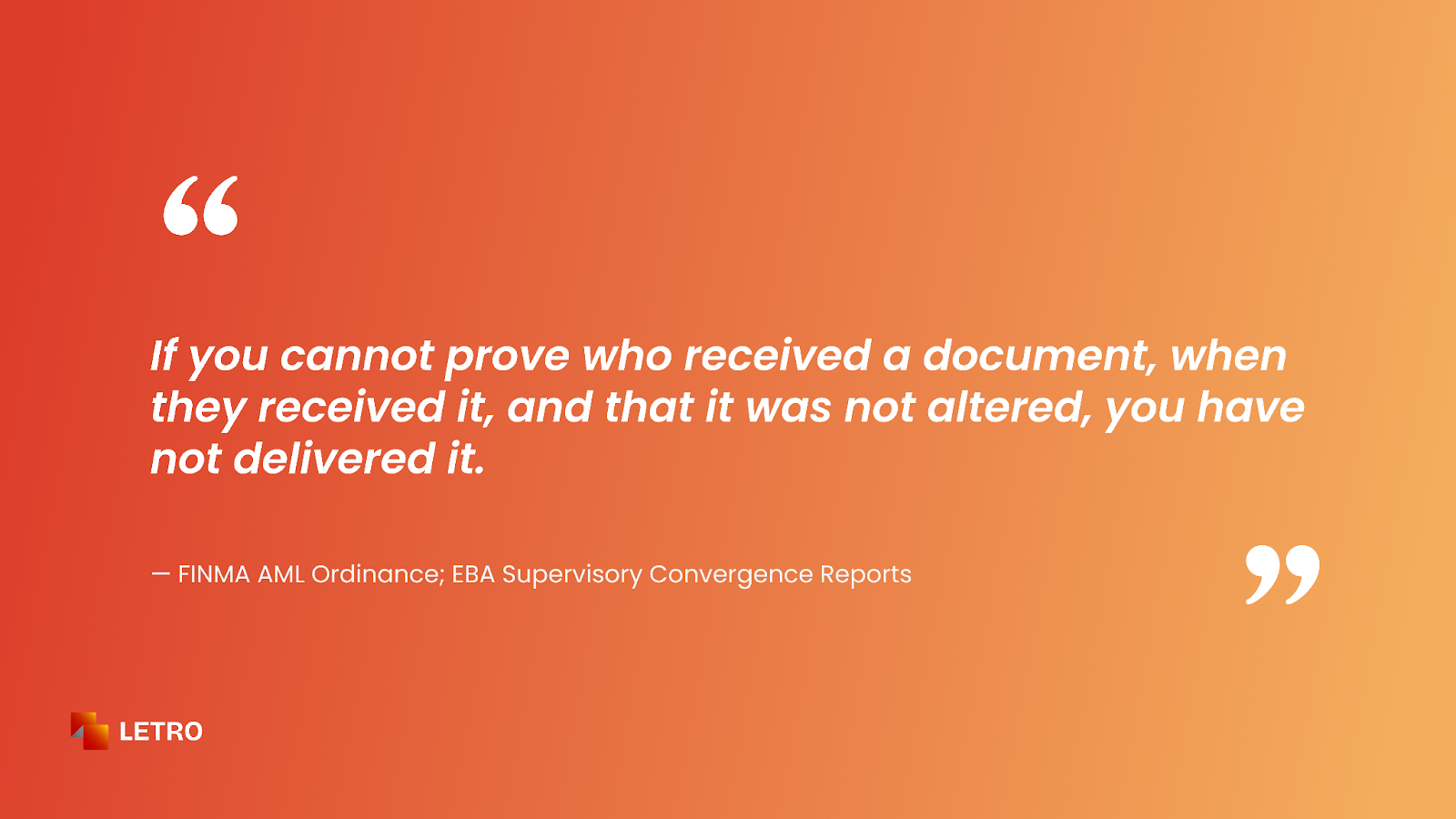
From a regulatory perspective, this is not a minor operational detail. FINMA’s AML framework and documentation expectations emphasize traceability and reconstructability, the ability to demonstrate what information was provided, to whom, and when. Similar findings appear in EU supervisory reviews, where regulators repeatedly identify gaps in post-onboarding communication evidence rather than deficiencies in initial KYC checks.
Email delivery, even when combined with ZIP passwords, fails to provide verifiable proof of receipt or immutable timelines. When challenged months later, during an audit, dispute, or client complaint, firms are left with fragmented records that are difficult to defend.
Loss aversion, not convenience, drives professional risk decisions
Asset managers are structurally risk-averse, not because of culture, but because of incentives. The downside of a communication failure. client mistrust, remediation work, legal review, or supervisory scrutiny. far outweighs any marginal efficiency gained from email-based workflows.
Behavioral finance research consistently shows that professionals act more decisively to avoid losses than to pursue incremental gains. This logic explains why Tier-1 private banks invested early in secure client vaults and formal digital correspondence channels. The cost of not having provable delivery and acknowledgment was deemed unacceptable long before clients explicitly demanded it.
Independent firms face the same downside risks today, with fewer buffers and less tolerance for operational error.
Your clients already understand what “secure” means
HNWI and UHNWI clients benchmark their advisors against their private banks, not against other independent firms. Large institutions have trained clients to expect authenticated access, clear separation from email, and explicit confirmation when regulated documents are delivered.
Industry research shows that trust erosion rarely happens through investment underperformance alone. It accumulates through small operational inconsistencies, especially around data protection and discretion. When an independent manager relies on ZIP-protected attachments, the implicit signal is that communication standards are lower than those of a bank.
This perception matters during mandate renewals, asset consolidation decisions, and advisor comparisons, even if it is never stated explicitly.
Secure communication becomes valuable after onboarding, not during it
Onboarding is episodic. Communication is continuous.
Monthly asset allocation reports, investment notices, and tax-related correspondence represent the bulk of sensitive client interactions over the life of a mandate. These documents are precisely where delivery certainty, identity verification, and time-stamped records reduce operational risk.
When implemented as formal digital correspondence, rather than generic portals, secure delivery creates a verifiable audit trail and aligns independent firms with private-banking standards. This also explains why secure communication can be evaluated as a premium service rather than a sunk compliance cost. Clients already value this experience elsewhere; extending it to advisory communication is a natural expectation.
Mockups, such as a branded secure letter delivering an asset allocation report directly to a client’s device, illustrate how this shifts secure communication from onboarding hygiene to ongoing value.
What regulators actually look for is boring and non-negotiable
Supervisors do not assess communication tools based on design or convenience. They assess outcomes. Across Swiss and EU frameworks, three questions recur: can delivery be demonstrated, is the record tamper-evident, and can the timeline be independently reconstructed?
These expectations are reflected in FINMA’s documentation principles, GDPR accountability requirements, and repeated supervisory findings on communication failures across financial institutions. Email and ad-hoc file sharing consistently underperform against these criteria. Formal digital correspondence channels are explicitly designed to meet them.
The strategic takeaway for Swiss EAMs and trustees
Secure communication should not end once onboarding is complete. That is precisely where its strategic value begins.
Used consistently, it reduces operational exposure, strengthens client trust, and supports premium positioning, without altering investment strategy, custody, or reporting content. It is a quiet control that prevents visible failures.
If a document would be unacceptable to misdeliver, forward unintentionally, or fail to evidence later, it should never leave your firm as an email attachment.
Letro is a secure, end-to-end encrypted FormalCommunication platform designed for mobile and desktop use. To get more information, request a demo.
