

Introduction
Public bodies and regulated organizations often retain paper notices because they appear official and because legacy procedure treats “sent by post” as a compliance milestone. But citizens experience “official” differently: a notice is only effective when it reaches the right person in time, and can later be proven under audit or dispute. When that reliability is missing, organizations absorb avoidable churn, repeat contacts, reissued notices, escalations, and contested outcomes.
The friction is structural. Paper delivery depends on address stability and postal performance, while many compliance frameworks ultimately depend on evidentiary outcomes: identity, integrity, trusted time, and provable receipt. Paper can carry content, but it does not consistently produce those proofs.
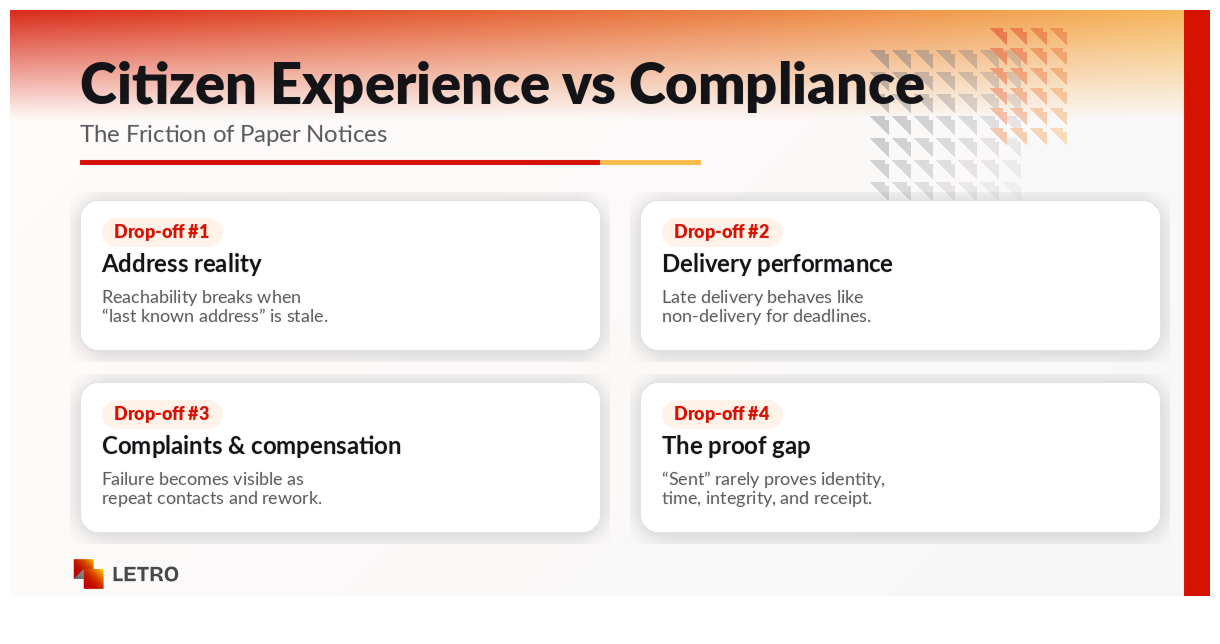
1) Address reality (reachability)
Modern populations are mobile, and “last known address” is often an administrative convenience rather than a reliable service endpoint. The U.S. Census Bureau reports that 11.8% of the population moved to a different residence in 2024.
Postal oversight data shows what this means at scale. The USPS OIG reported that in FY2014, the Postal Service processed 155+ billion mail pieces and 6.6 billion (4.3%) were Undeliverable-As-Addressed (UAA). It also reported the Postal Service spent nearly $1.5B handling UAA mail, and that the mailing industry incurred about $20B in UAA costs annually.
Even where address intelligence exists, compliance regimes may still require sending notices to the “last known address,” preserving the reachability gap as a predictable feature of paper workflows.
2) Delivery performance (timeliness)
For time-bound notices (benefits decisions, penalties, hearings, appeals), “late” behaves like “not delivered.” Ofcom’s UK postal monitoring reports that delayed mail remains the most commonly experienced issue, cited by 25% of residential users in its consumer research.
Ofcom also documents performance shortfalls against regulated service targets. In 2023–24, Royal Mail First Class achieved 74.5% against a 93% target, and Second Class 92.4% against a 98.5% target. In 2024–25, Ofcom reports First Class was 77% against the 93% target and Second Class 92.5% against 98.5%, and it notes that in October 2025, it fined Royal Mail £21 million for failing to meet its First and Second Class delivery targets.
Citizen impact: uncertainty and procedural disadvantage (especially when notice triggers rights or deadlines).
Organizational impact: downstream rework, service recovery effort, and heightened challenge rates.
3) Complaint and compensation churn (observable fallout)
When delivery becomes unreliable, complaint volumes rise, and compensation becomes a recurring cost signal.
Ofcom reports Royal Mail’s completed complaint volumes increased to 2.55 million in 2023–24 (up from 1.98m), and that total compensation paid increased to £31.6 million in 2023–24.
These indicators are not merely “customer service issues.” In regulated correspondence, they translate into administrative burden: repeated contacts, duplicate documentation, and prolonged case cycles.
4) The compliance “proof gap”: sent is not the same as proved
Paper can often demonstrate that a notice was produced and dispatched. It frequently cannot demonstrate at audit standard who actually received it, when it became available, whether content integrity remained intact, and whether receipt/acknowledgment occurred.
This is why “citizen experience vs compliance” is usually a false choice. Compliance is not a preference for paper; it is a preference for verifiable outcomes, identity, integrity, trusted time, and receipt when decisions are challenged.
Why “going digital” is not sufficient
Many organizations attempt to solve paper friction with email or basic portals. This can reduce print and postage, but it often recreates the same proof gap in digital form: unclear identity binding, weak receipt semantics (open ≠ received), and fragmented audit records across systems.
The objective is not “paper vs digital.” It is inferential delivery vs verifiable delivery.
What verifiable digital changes (and why it reduces churn)
EU trust-services policy is explicit about the evidentiary outcomes expected from registered delivery. The European Commission describes Electronic Registered Delivery Services (ERDS) as providing secure and reliable delivery and evidence of time of sending, receipt, and content integrity.
The legal effect is also articulated: data sent and received using an electronic registered delivery service shall not be denied legal effect and admissibility as evidence solely because it is electronic.
Technical standards align with this “evidence first” framing. ETSI’s Registered Electronic Mail (REM) specifications describe registered e-mail services as providing a set of evidence suitable to uphold assertions of acceptance (shipment), delivery/non-delivery, and receipt.
Operationally, this reduces churn because disputes become resolvable facts:
- Fewer “where is my notice?” contacts when availability and timestamps are provable.
- Fewer reissues when the delivery state is machine-verifiable rather than inferred.
- Faster case progression when acknowledgments and integrity proofs are generated by design, not reconstructed manually.
A public-sector reference point: designing delivery as infrastructure
Denmark’s Digital Post illustrates the policy pattern: define a legally recognized digital mailbox, set mandatory coverage with exemptions, and treat digital delivery as binding for official correspondence.
Denmark’s Agency for Digital Government notes Digital Post became obligatory for businesses on 1 Nov 2013 and for residents on 1 Nov 2014. Rigsrevisionen reported prospects of public-sector savings of approximately DKK 1 billion annually associated with the transition to mandatory Digital Post.
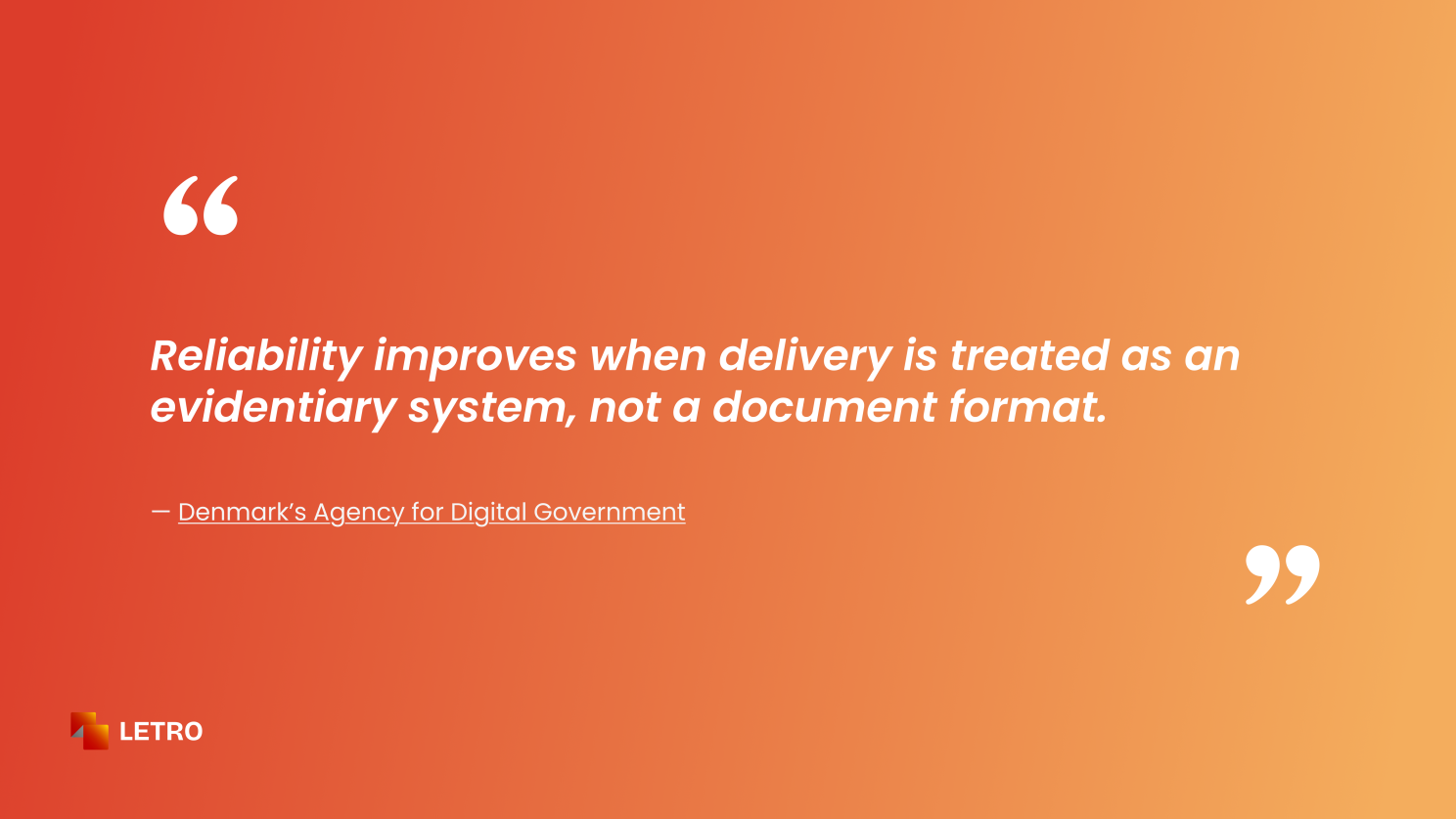
Whether or not a jurisdiction adopts Denmark’s exact model, the transferable lesson is: reliability improves when delivery is treated as an evidentiary system, not a document format.
A measurement model for “reduced churn”
To quantify citizen experience improvements without weakening compliance, track metrics that paper systems often cannot prove end-to-end:
- Reachability: UAA/return rate; address mismatch rate; time-to-correction.
- Timeliness: time-to-availability; % delivered inside/outside service window; deadline-risk rate.
- Proof completeness: % with identity binding, tamper-evident integrity, trusted timestamp, and receipt/acknowledgment evidence.
- Churn signals: repeat contacts per 1,000 notices; reissue rate; dispute rate; time-to-resolution for non-receipt claims.
Conclusion
Paper notices can satisfy a procedural tradition, but the evidence shows stable, measurable friction: address volatility, documented delivery under-performance against targets, and large complaint volumes with escalating compensation.
A modern standard is therefore not “digital instead of paper.” It is verifiable delivery instead of inferential delivery channels that produce reproducible artifacts (identity-bound access, integrity proofs, trusted timestamps, and receipt evidence) suitable for audit and dispute.
The strategic shift is simple: treat official delivery as an evidentiary outcome. When proof is built in, citizen confidence rises, and organizational churn falls because certainty becomes measurable and repeatable, not assumed.