

Introduction
Across appeals, administrative review, and legal services, the form of an official letter still carries weight. What fails, however, is not the format but the absence of verifiable proof. Postal and email workflows often cannot demonstrate who received the letter, when it was accessed, or whether custody remained intact. These gaps recur in contested appeals, compliance actions, and court-service disputes.
Regulators continue to document the problem. The UK’s Information Commissioner’s Office reports that “data sent to the wrong recipient” remains one of the most common incident types in public-sector correspondence (ICO Data Security Incident Trends).
This article outlines typical failure modes in paper and email workflows, and then shows how a digital proof model, identity-bound delivery, time-stamped events, and sealed audit trails resolve them.
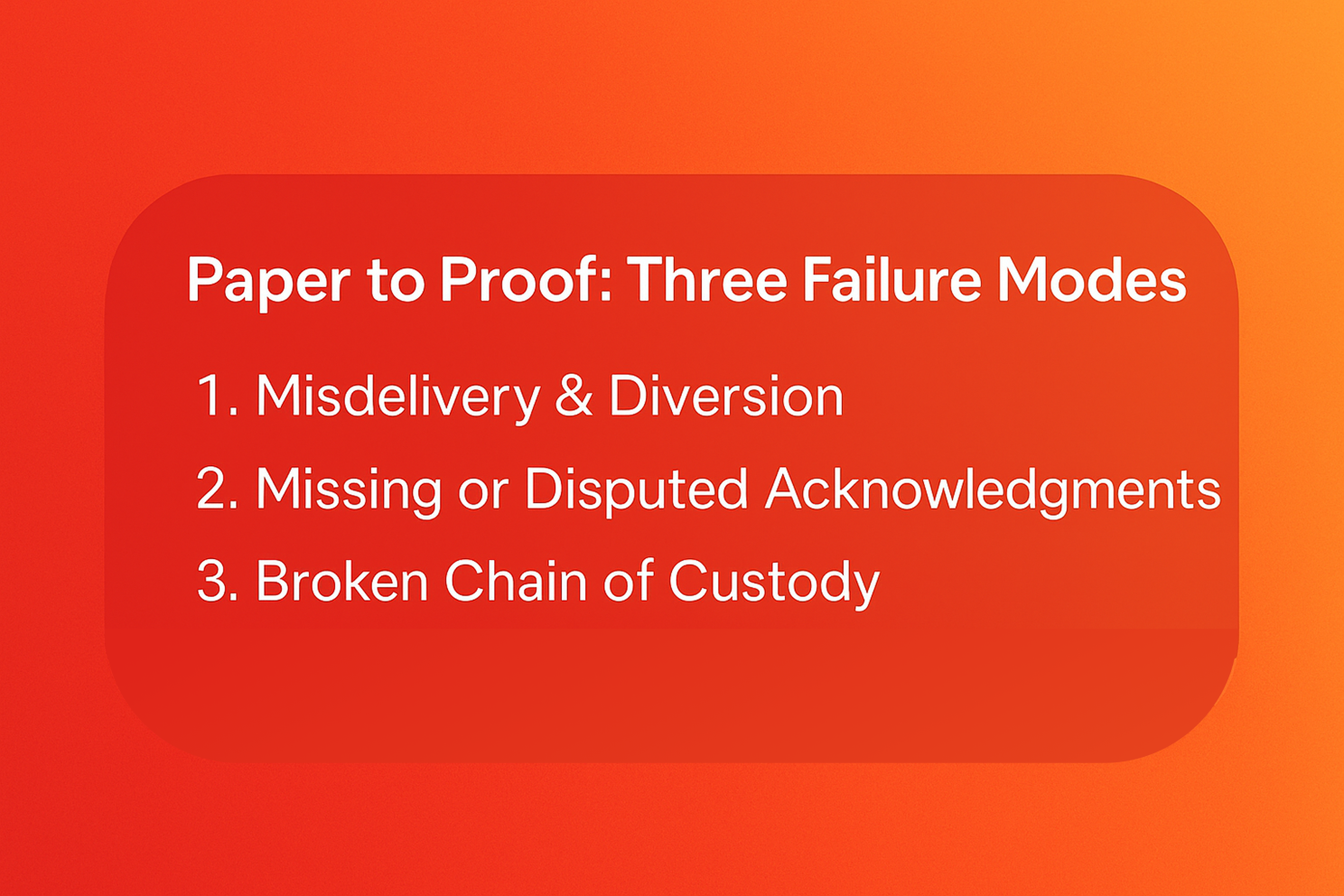
1. Misdelivery and diversion in appeals
Appeals often depend on precise deadlines. The paper introduces three recurring gaps:
A. Incorrect recipient or unlogged handoff
A delivery scan confirms movement, not identity. Postal systems do not provide a binding record of who actually received the letter. Shared mailrooms, internal mail cages, and unrecorded handoffs routinely break the chain of custody. UK National Audit Office guidance notes that postal tracking “does not confirm which individual accessed the correspondence,” leaving organizations exposed during audit or challenge.
B. Forwarding and address drift
Appeal participants often move between interim addresses (temporary housing, care facilities, student halls). Postal redirection extends transit time and creates blind spots, especially when a forwarding request expires.
C. Internal routing delays
In courts, tribunals, and administrative bodies, incoming mail passes through several desks before reaching the intended case officer. Each handoff adds delay, and none creates an identity-based receipt.
Case in Point
NHS clinical correspondence backlog (UK): A National Audit Office investigation found a backlog of 709,000 items of clinical correspondence that weren’t routed correctly; NHS England estimated administration costs of at least £6.6m (later cited as rising towards £9m), plus £2.5m paid to GP practices to review potential harm.
One documented issue: an item addressed only with a postcode was delivered to a supermarket, illustrating how postal scans show movement, not who actually accessed the content.
Undeliverable‑as‑Addressed (UAA) burden (US): The U.S. Postal Service OIG reports USPS spent ~$1.5 billion handling UAA mail in FY2014 and that mailers incur ~$20 billion annually due to UAA (forwarding, returns, waste). This is not “one-off”—it’s structural friction baked into paper routing.
2. Missing or disputed acknowledgments
Paper and email both fail when officials or appellants disagree on whether a notice was received or opened.
A. Email cannot prove access
Even when technically delivered, email offers no authoritative record of who actually accessed the letter. Forwarding, auto-sorting, spam filtering, and shared inboxes erase attribution.
The Information Commissioner's Office repeatedly highlights wrong-recipient email as a leading incident, illustrating the fragility of attribution in email-based workflows.
B. Paper acknowledgments arrive late or not at all
Return receipts depend on physical handling. Lost cards, unsigned envelopes, and delayed returns cause missed deadlines. In administrative appeals, this can render an entire decision invalid.
C. Attachments lack evidentiary structure
PDFs sent by email do not produce a time-stamped, tamper-evident receipt. They can be forwarded or altered without a trace.
Case in Point
Aetna (US): A 2017 mailing with HIV‑related information visible through window envelopes triggered a $17 million class‑action settlement and a $175,000 penalty from the DC Attorney General; in New York, the Attorney General secured a $1.15 million settlement over the same incident. This shows how paper acknowledgments can fail and create high exposure.
Sentara Hospitals (US): Billing statements for 577 patients were merged with 16,342 different guarantor mailing labels, disclosing PHI to the wrong recipients; the organization paid $2.175 million to resolve HIPAA violations. Again, delivery occurred, but to the wrong identity, and no authoritative access receipt existed.
3. Broken chain of custody during legal service
Legal service requires demonstrable control over who sent the letter, who received it, and when the event occurred. Paper and email provide partial, often insufficient records.
A. Paper establishes movement, not identity
A postal scan shows that an item moved from point A to point B. It does not show who opened the letter, whether it reached the correct person, or whether it was intercepted.
B. Service to organizations breaks on internal distribution
When serving a corporation or public body, mailroom staff may sign for delivery without logging which officer ultimately accessed the letter. In challenges, organizations frequently claim non-receipt.
C. Email creates unverifiable trails
Email headers are easily disputed. Recipients may assert that a notice went to spam, that the mailbox was shared, or that they never opened the attachment.
D. Evidentiary exposure during audit or dispute
Without a tamper-evident audit trail, organizations must reconstruct delivery events manually, an error-prone process that increases administrative cost.
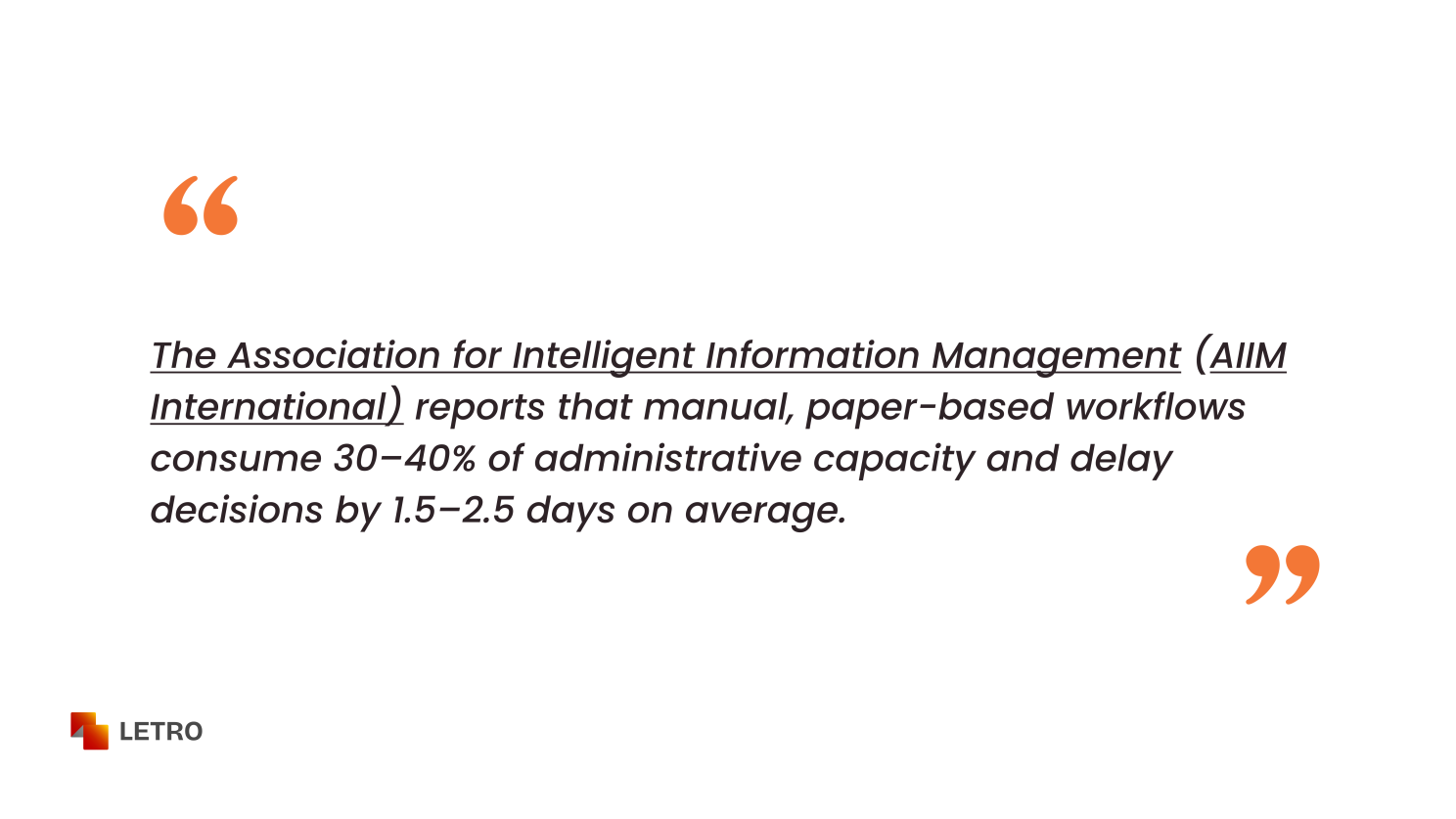
The Association for Intelligent Information Management (AIIM International) reports that manual, paper-based workflows consume 30–40% of administrative capacity and delay decisions by 1.5–2.5 days on average.
Case in Point
Tusla, Ireland’s Child & Family Agency (Ireland): Multiple GDPR enforcement actions included €75,000 in fines and a separate €40,000 fine for mailing a letter with abuse allegations to the wrong recipient, who then posted details publicly. This is classic chain‑of‑custody failure: a formal notice reached someone, but not the right person, and no identity‑bound receipt existed.
ICO: email disclosure discipline (UK): Gloucestershire Police were fined £80,000 after a bulk email exposed abuse victims’ identities; the email reached recipients but lacked per‑recipient identity control.
4. Deadline exposure in statutory appeals
The most sensitive point is the deadline. Appeals often depend on:
- Date of sending,
- Date of receipt,
- Date of access,
- Date of acknowledgment.
Paper and email create uncertainty in each.
A. “Deemed delivery” rules do not solve factual disputes
Courts may assume a letter arrived within a fixed period, but appellants frequently challenge the presumption. When a decision turns on a deadline, those disputes become substantive.
B. Email timestamps lack identity context
A timestamp on an email server does not prove who accessed the digital document or when.
C. Returned or misrouted post breaks the timeline
When a letter returns as undeliverable, the organization may not discover the failure until after the statutory window has closed.
Case in Point
Set‑aside risk when post misses the person (UK & US practice): According to the UK ministry of Justice, Courts routinely vacate defaults or quash service if a party shows they were not properly served (e.g., service to an empty office or incorrect address), forcing re‑service and re‑litigation—with direct legal cost and de
5. Record-keeping, audit, and policy compliance
Appeals bodies and courts must maintain reliable archives. The paper introduces both cost and evidentiary uncertainty.
A. Escalating storage and retrieval cost
Document-management studies show that misfiled paper costs ~$120 to locate, and employees spend up to four weeks per year searching for physical records (PwC-cited industry analysis).
B. Incomplete or inconsistent retention
Paper files may be scanned late, filed inconsistently, or lost during transitions.
C. Fragmented evidence during audit
Paper receipts, email threads, and system logs often live in different repositories, making audits resource-intensive.
Case in Point
Paper retrieval & misfile costs (industry benchmarks): Long‑standing AIIM/PwC benchmarks (often cited in records‑management literature) put misfiled paper search at ~$120 per document, with additional productivity loss from manual retrieval. While figures vary by study, the direction is consistent: paper archives consume budget and time and complicate audit reconstruction
Proof in practice
A secure digital letter resolves the gaps seen in paper and email by binding every step of delivery, access, acknowledgment, and custody to verified identity and time-stamped events. Instead of fragmented evidence such as postal scans or email headers, organizations receive a single proof package: verified delivery, identity-confirmed access, logged acknowledgments, and a tamper-evident audit trail. The result is a consistent, sealed record suitable for statutory deadlines, appeals, and oversight reviews, preserving the formality of letters while restoring evidentiary certainty.
Safe-claims note: Legally recognized digital delivery options exist in many regions; organizations should confirm local requirements before implementation.
Conclusion
Appeals and legal services depend less on the format of a letter and more on the proof surrounding it. Paper and email lack identity, custody, and time-stamped acknowledgment. These gaps generate avoidable disputes, administrative costs, and deadline risk.
A secure digital letter, identity-bound delivery, verified access, tamper-evident audit trail, and exportable proof restores operational certainty. The formality of letters is preserved; the evidentiary strength is upgraded.