
We read 673 SRA scam alerts. Half the firms we measured had not locked their own address, and most scammers did not need it.
Original study: we read every scam alert on the SRA’s list from January 2025 to September 2026, then checked the email settings of the 251 named firms whose domain the SRA stated. 51% enforce DMARC. For 133 of the 251, the closest fake address was a near copy of the firm’s own, which that setting does not cover.
The brief
Half of the firms that scammers posed as have not asked inboxes to block or flag fakes of their own email address. For most firms the scammers did not need that gap: the address quoted in the alert only looked like the firm’s, or had nothing to do with it. And on 152 of the 192 firm websites we could read, we found no route for a client to check a payment instruction.
We read the 673 scam alerts on the SRA’s list dated 1 January 2025 to 30 September 2026. 497 of them misuse a real firm’s name or details, and they name 371 different firms. The SRA stated a domain we could measure for 251 of those firms, and the figures here are about them. They are the firms the SRA named, not a sample of law firms, and the alerts count what the SRA published, not how often fraud happens.
The full record
What we counted
The Solicitors Regulation Authority (SRA) publishes scam alerts about people and websites that pretend to be solicitors or law firms. We read every alert on its list dated 1 January 2025 to 30 September 2026: 673 alerts.
In 497 of them (73.8%) a real firm’s name or details were misused. Those 497 alerts name 371 different firms. 296 firms appear in one alert and 75 in two or more; the most any one firm appears in is 13.
The other 176 alerts are not in the firm counts. 131 misuse a real solicitor’s identity for a firm that is fictitious or not authorised, 38 name a fictitious firm only, 6 impersonate a non-law organisation or a regulator, and 1 is unclear.
Email is named in 331 of the 497 firm alerts (66.6%). An alert can name more than one channel: 148 name a letter or document (29.8%), 129 a website (26.0%), 112 a phone call (22.5%) and 58 a messaging app or text (11.7%).
What the setting does, and what it does not
DMARC is an email setting that a firm publishes for its domain. It asks a receiving mail system to do one of three things with mail that claims to come from that domain but fails the domain’s own authentication checks: nothing (p=none), treat it as suspicious (p=quarantine) or refuse it (p=reject). A related setting, SPF, lists the servers allowed to send for the domain and ends in -all (fail) or ~all (soft fail).
DMARC covers one case: mail that uses the firm’s exact domain as the sender. It says nothing about a different domain that looks like the firm’s, a free-mail address, a letter or a phone call.
Where the 251 firms stand
The SRA stated a domain we could measure for 251 of the 371 firms (67.7%). We read their DNS records on 17 November 2026. The settings are as on that day, not as they were when the alert was published.
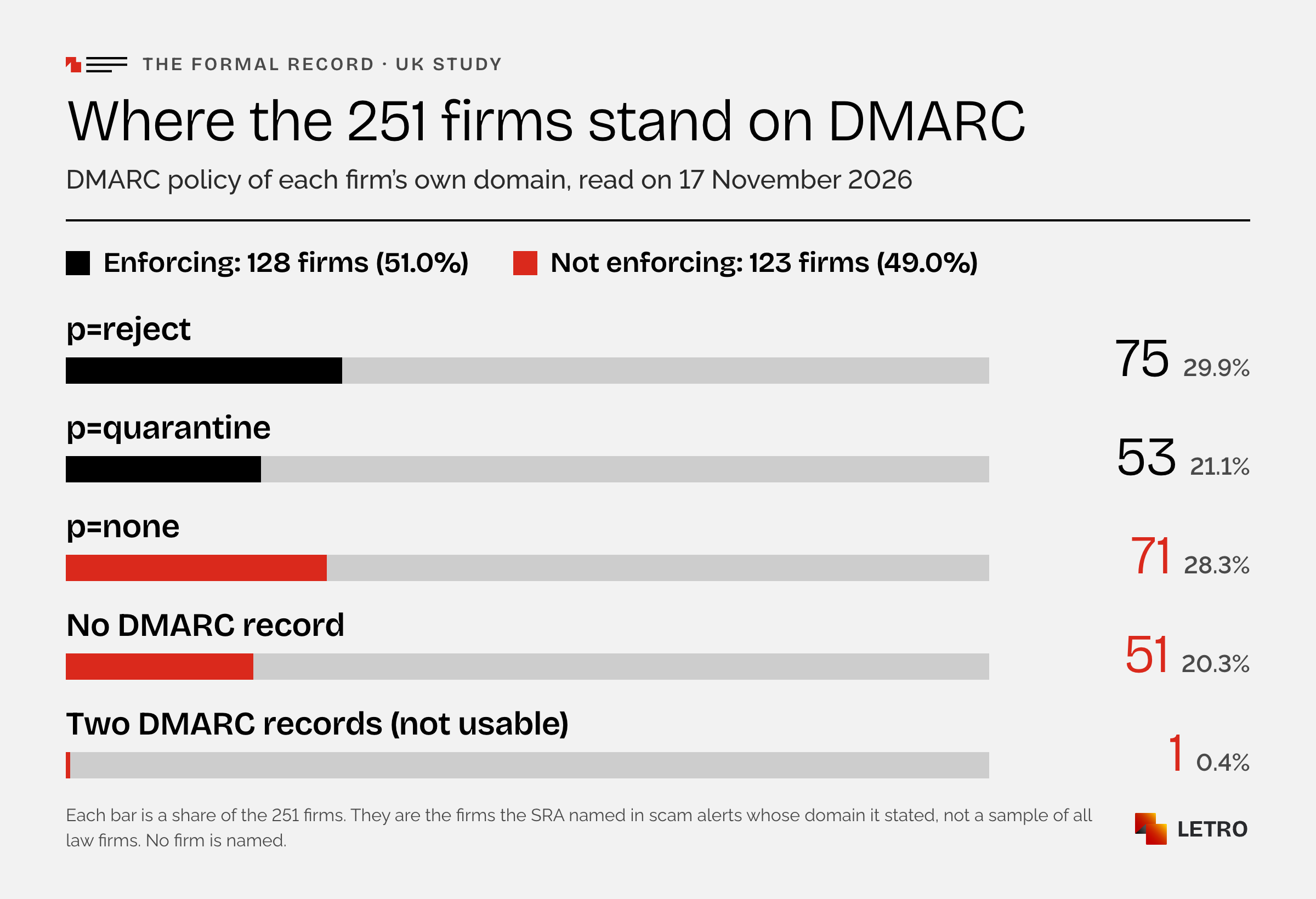
128 of the 251 firms enforce DMARC. 123 do not.
128 of 251 (51.0%) enforce DMARC. 123 (49.0%) do not: 71 publish p=none, 51 publish no DMARC record and 1 publishes two records, which a receiving system cannot use.
For SPF, 140 firms (55.8%) end their record with -all and 108 (43.0%) with ~all. 2 use ?all or +all and 1 publishes no SPF record.
The picture moved while we worked. On 1 October, 120 of 250 firms (48.0%) enforced DMARC. Between 1 October and 17 November, 22 of the firms published or tightened a DMARC record. DNS records cannot tell us why.
What the scammers used instead
For each firm we took the fake domains quoted in its alerts and kept the one closest to the firm’s own domain.
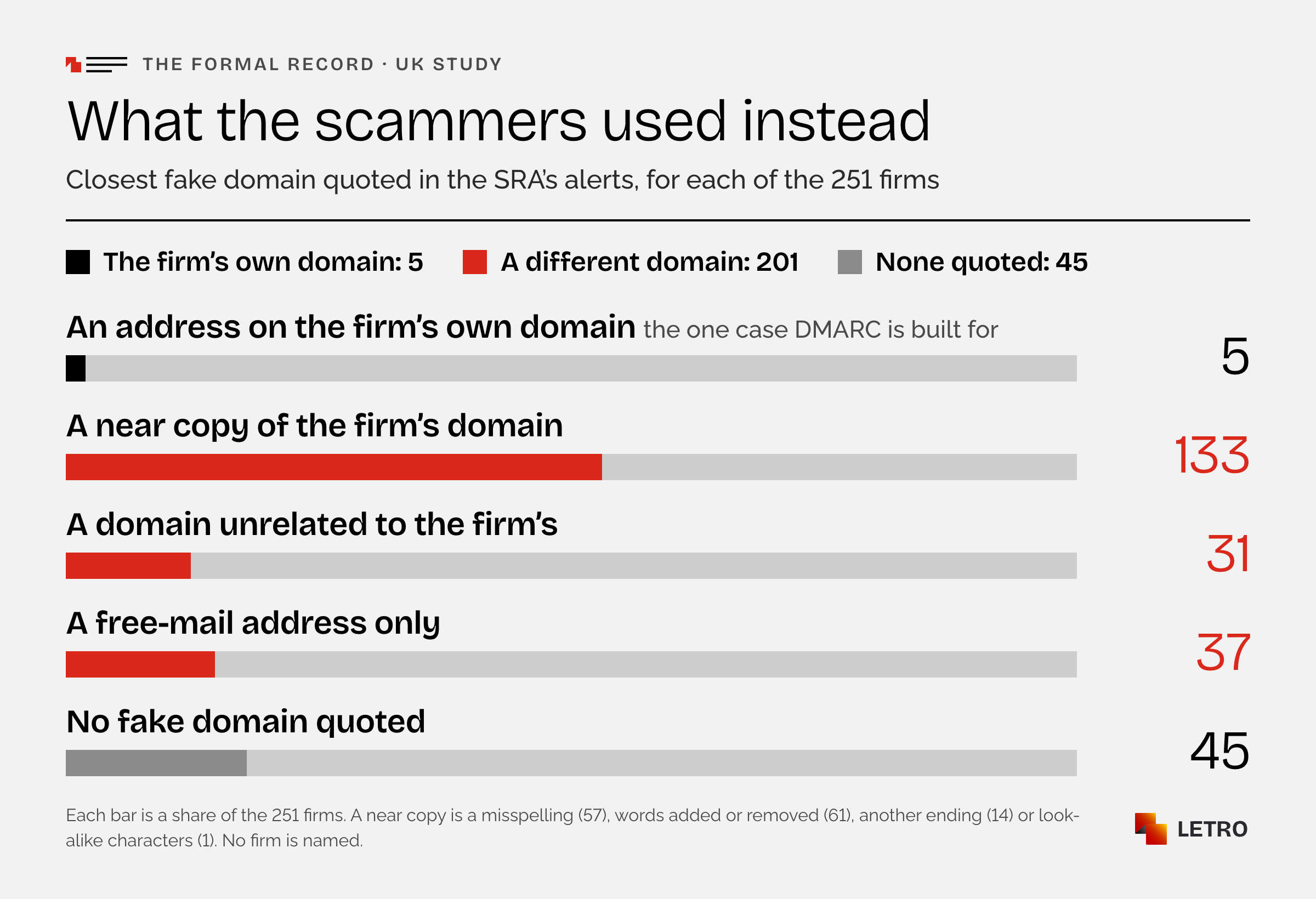
A near copy is a misspelling (57 firms), words added or removed (61), another ending such as .com for .co.uk (14) or look-alike characters (1). An invented pair, to show the kind: yourfirm.co.uk copied as yourfirm-law.co.uk.
Only the first bar is the case DMARC is built for, and it holds 5 firms (2.0%). In those alerts an address on the firm’s own domain was quoted; the alerts do not say how it was used. For 133 firms (53.0%) the closest fake domain was a near copy. The sender setting of the real domain says nothing about a copy registered under a different name.
Only 5 of the 251 firms are in the one case DMARC is built for. For 133, the fake address was a near copy of the firm’s own.
Put together, 201 of the 251 firms (80.1%) had a closest fake address on a domain that was not the firm’s: a near copy (133), an unrelated domain (31) or a free-mail address (37).
We do not claim that p=reject would have stopped any alert. The alerts do not say how each message was sent.
What the firms’ websites say
We also read up to five public pages on the websites of 233 of the 251 firms: home, contact and up to three on fraud, terms, fees or privacy. 192 of the 233 could be counted. Each figure below is a share of those 192, with a floor (what we found) and an upper figure (the floor plus every firm we could not code):
- A warning about payment fraud: at least 25 (13.0%), at most 41 (21.4%).
- A route for checking a message or payment instruction, such as calling the firm or the usual contact: at least 16 (8.3%), at most 40 (20.8%). For 152 firms (79.2%) we found no such route on the pages read; 24 (12.5%) are unclear.
- An invitation to contact the firm on WhatsApp: 11 (5.7%).
On 152 of the 192 firm websites we read, we found no way for a client to check a payment instruction.
“No” means not found on the pages read, not that the firm has none. A line saying a firm’s SRA number can be checked on the SRA’s register is not counted as a route for checking an instruction. The pages were read on 5 to 7 October 2026.
What this does not show
- The firms are not a sample of law firms. They are the firms the SRA named in scam alerts, and 251 of the 371 are those whose domain the SRA stated. The other 120 state no domain (108), have no own domain (11) or are closed (1). Nothing here describes law firms in general.
- Alerts count what the SRA published. They do not show how often fraud happens, how many clients were reached or how much was lost.
- The list is not the whole site. The SRA’s date-filtered list showed 673 alerts for these dates when we read it on 1 October. Searching the site by keyword turned up 248 more alerts dated in the same period. We counted the list and used the larger set only as a check.
- Borderline firms. For 21 of the 371 firms the SRA’s text is ambiguous about whether the real firm’s details were misused; 5 of them are among the 251 measured. We kept them. Without them, 1 of 49 comparable shares moves by more than 2 points, by 2.4 points.
- Settings change. DNS records are as of 17 November, websites as of 5 to 7 October.
- Websites. 41 of the 233 firms gave no usable website data (38 would not load or were not accessible, 3 where we lost the records), so the website figures say nothing about them. 17 more firms are left out of the website counts because their robots.txt asks for a Crawl-delay that our requests did not meet, and one is closed.
- Coding. We coded the alerts and the websites ourselves. A second AI reviewer, not a human, re-coded a random 10% of each: 56 of 60 alert classes agreed (93%) and 31 of 32 fake-domain relations (97%); 57 of 60 website codes agreed (95%).
What this adds up to
DMARC is worth setting, and half of these firms have not set it to act. But it closes one door. For 201 of the 251 firms, the scammers’ address sat on a different domain, and a different domain can pass the same email checks, because it only vouches for itself.
DMARC closes one door. For 201 of the 251 firms, the scammers came through another.
The same goes for encryption. It keeps a message private on its way. It does not tell a client who wrote it.
So the last check sits outside the message: a client who knows that bank details never change by email, and who calls a number they already hold before paying. On 152 of the 192 websites we read, we found no such instruction.
What a firm can check
- Whether its own domain’s DMARC policy is quarantine or reject. Its IT provider can look it up.
- Whether its clients know how it will and will not communicate a change of bank details. One sentence is enough: “We never send a change of bank details by email. Before you pay, call the number in your client care letter.”
- Whether copies of its name or domain exist, and reporting any it finds to the SRA.
“We never send a change of bank details by email. Before you pay, call the number in your client care letter.”
The second and third checks follow the SRA’s warning notice “Bogus law firms and identity theft”. This is information, not legal advice; the firm’s compliance officer (COLP) or counsel decides what to do.
Ask for your own firm’s result
Any firm can ask us to measure it the same way, whether or not it appears in an SRA alert. We read the firm’s DMARC and SPF records and up to five public pages of its website, and send back what we found next to the totals above. The result goes only to an address on the firm’s own domain. It holds nothing from the SRA’s alerts and nothing about any other firm.
To ask, write to us through letro.com/contact-us from your work address and give your firm’s website.
Letro’s own domain
We read Letro’s own domain the same way on 17 November: DMARC p=quarantine, SPF ending ~all. We set it to p=reject later the same day, and a second reading that afternoon shows p=reject.
Source: scam alerts published by the Solicitors Regulation Authority at sra.org.uk, read and coded by Letro. The Formal Record includes data supplied by the Solicitors Regulation Authority. This record has not been reviewed or endorsed by the SRA.
We used public information only. We did not contact any firm, submit any form, log in anywhere or connect to a mail server. We read each site’s robots.txt first and never opened a page a site refused. We spaced our requests to a site at least two seconds apart, with exceptions we logged: in the first reading of the SRA’s list and alert pages we count at least 13 gaps under two seconds among 1,464 requests, because those logs record when responses came back, not when requests started. On 6 October we re-read all 921 alert pages we had found with every gap at 2.1 seconds or more.
DNS records were read on 17 November 2026 over DNS-over-HTTPS from two public resolvers (Google Public DNS and Cloudflare 1.1.1.1). A first reading on 1 October gave 48% enforcing DMARC; 22 of the firms published or tightened a DMARC record between the two dates. The website check covers 233 of the 251 targeted firms: 17 firms whose robots.txt asks for a Crawl-delay that our requests did not meet are excluded from it, and one firm is closed. No website page has been read since 7 October.
Each of the 1,540 DNS answers was checked by length and checksum before it was read, and the two resolvers agreed for every firm. The 673 alerts were all read and coded; the monthly counts match the SRA’s own filter counts for all 21 months.
- Solicitors Regulation Authority, scam alerts: the 673 alerts on the list dated 1 January 2025 to 30 September 2026, read on 1 October 2026; the alert pages were re-read on 6 October 2026.
- Solicitors Regulation Authority, warning notice “Bogus law firms and identity theft”.
- Public DNS records (DMARC and SPF) of the 251 firms’ domains, read on 17 November 2026 through Google Public DNS and Cloudflare 1.1.1.1. A first reading was taken on 1 October 2026.
- Public pages of 233 of the firms’ websites, read on 5 to 7 October 2026. No firm is named, so the pages are not listed.