FR-2026-0062

Fraud reports are rising. Only 4 of 300 Swiss firm websites warn clients

Fake emails in a firm’s name need no break-in: the firm is impersonated, not hacked. We checked what a random sample of Swiss portfolio managers and trustees tell their clients, and what their email settings ask inboxes to do. Most of the 303 firms we measured have not fully switched on the setting that asks inboxes to block or flag fake mail sent from their exact address.

Report
4
November 25, 2026
November 25, 2026
1.1
Finance, Fiduciaries & trustees
Verification
Sina Tadayon
Editor, The Formal Record
10
1
4
of the 300 websites we read carry a warning about fake emails, calls or payment requests in the firm’s name.
Original study · FINMA list of portfolio managers and trustees, random sample of 450 · websites read 28 Oct to 24 Nov 2026 · email settings read 24 Nov 2026
1
of the 300 websites we read tells clients how to check a payment request or instruction.
About 2 in 3
firms we measured have not fully switched on the setting that asks inboxes to block or flag fake mail sent from their exact address.
About 4 in 10
firms we measured have not set up this email setting at all.
Ask your IT provider if your email setting (DMARC) asks inboxes to block or flag fake mail from your exact address. Tell every client in one sentence how you will and will not send a change of bank details. Look for copies of your web address that only look like yours, such as yourfirm-partners.ch for yourfirm.ch. The setting covers fakes of your exact address only. It does not cover a look-alike address, so your client’s own check is the last one.
The Formal Record is published by Letro, which sells secure client communication. This record is our own research. No firm is named in it. AI assisted the research and drafting.
1.1 | 25 Nov 2026 | Headline shortened. Three figures added. One sentence added to “What I conclude”. 1.0 | 25 Nov 2026 | First published.
swiss-portfolio-managers-trustees-impersonation-study
1

The brief

In short. Fake emails in a firm’s name need no break-in: the firm is impersonated, not hacked. We checked what a random sample of Swiss portfolio managers and trustees tell their clients, and what their email settings ask inboxes to do. Most of the 303 firms we measured have not fully switched on the setting that asks inboxes to block or flag fake mail sent from their exact address.

The firms are a random sample of FINMA’s list of licensed portfolio managers and trustees, not all Swiss firms. They are firms with a website we could find. The websites were read from 28 October to 24 November 2026 and the email settings on 24 November 2026. We counted settings and published pages, not fraud cases, victims or losses.

The full record

The argument

Reports of fraud by impersonation are rising in Switzerland

The Federal Office for Cybersecurity counted 971 reports of CEO fraud in 2025. The year before it counted 719. In CEO fraud a criminal poses as a manager, and sometimes as a lawyer, to get a payment made. The Office reports that the names of real Swiss law firms are used in these frauds to win trust. We know of no public count for portfolio managers and trustees. This study does not count them either. It measures how ready these firms are.

AI is making the fakes harder to spot

The same Office calls the growing use of AI a particular worry. Criminals use it to copy how a real person writes. They also use it to copy a voice, in calls and in voice messages. So a client can no longer rely on a message sounding right.

Two basic defences exist, and neither is new

The first is an email setting. When it is switched on, inboxes are asked to flag or block mail that fakes the firm’s exact address. It is a standard step that your IT provider can plan. It does need planning: switched on carelessly, it can stop your own mail too.

The second is one sentence to clients. It says how the firm will, and will not, ask for a payment or send new bank details.

The email setting stops at your exact address. It does nothing about a fake lookalike domain such as yourfirm-partners.ch, a free-mail address, a phone call or a copied voice. So the sentence to clients is the one defence that covers every route.
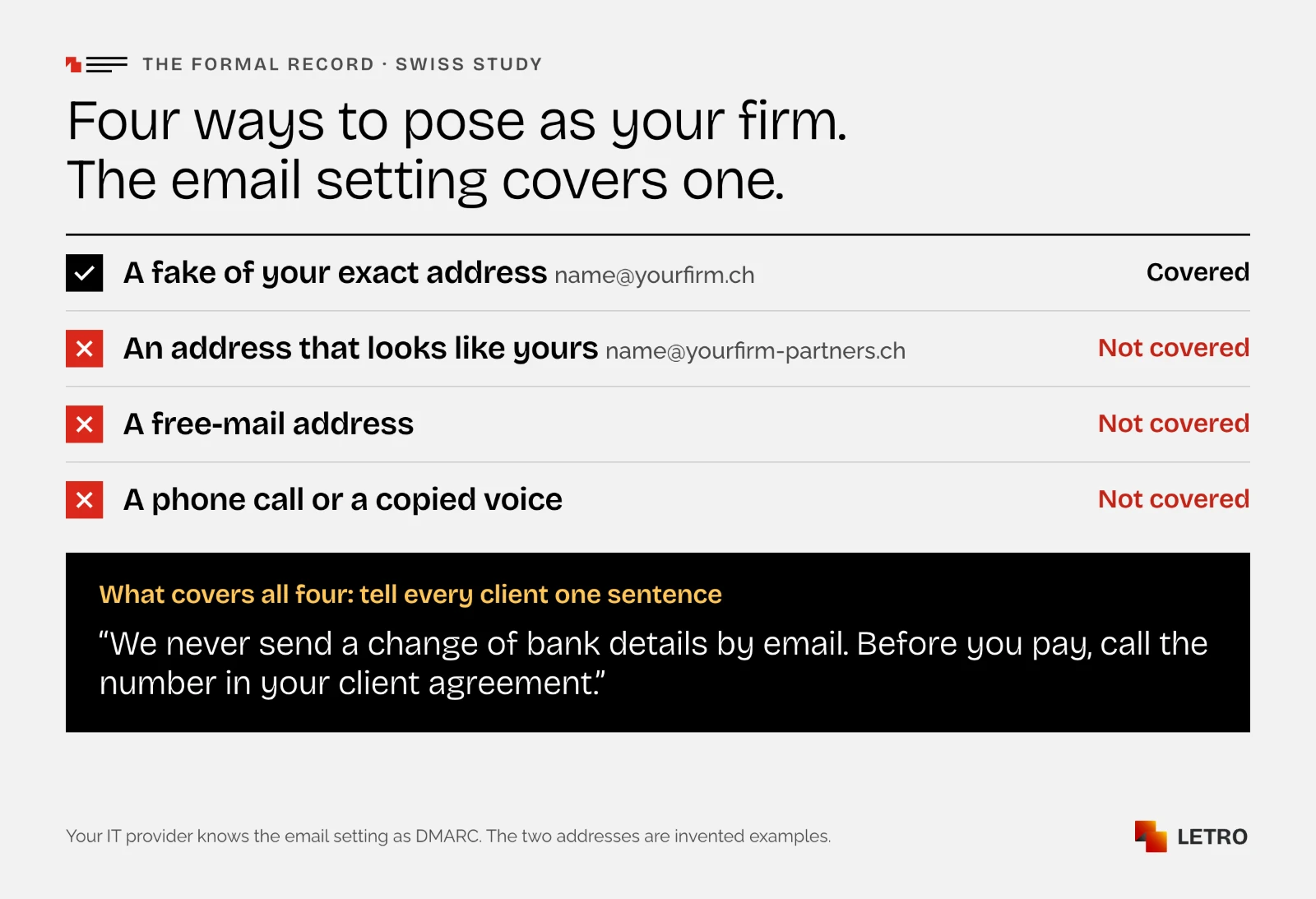
Four ways to pose as a firm: a fake of the exact address (covered by the email setting), a look-alike address, a free-mail address, and a phone call or copied voice (not covered). One sentence to every client covers all four.
The email setting covers a fake of the firm’s exact address. It does not cover a look-alike address, a free-mail address, a phone call or a copied voice. One sentence to clients covers all four.

Our study shows how few firms have them in place

We drew 450 firms at random from FINMA’s list and could measure 303. The results are fascinating and unexpected:

Two in three had not switched the email setting on. About 4 in 10 had not set it up at all. Only 4 of the 300 websites we read warn clients that someone may pose as the firm. Only 1 tells them how to check a payment request.

Stat card: only 4 of the 300 websites we read warn clients that someone may pose as the firm. 300 dots, 4 of them red.
Each dot is one of the 300 websites we read. The 4 red dots are the websites with a warning about fakes in the firm’s name.

Our earlier study of UK law firms points the same way. For 8 in 10 of those firms, the scammers used an address that was not the firm’s own. The email setting does not cover that.

What I conclude

In the age of impersonation, clients must be educated about the risks.

Clients are not being taught what a real request from their firm looks like. Firms may teach it in the client agreement, in person or on a call. We could not see those. But the website is the one place every client can reach at the moment of doubt, and it costs one sentence. This is an urgent matter which must be addressed as soon as possible.

The Federal Office for Cybersecurity gives companies the same advice for their own payments: confirm a request by calling a number you already know. As the fakes get better, that habit will matter more than any setting.

The study

The sections below are the evidence for the argument: what we counted, what we found, and where it stops.

What we counted

FINMA, the Swiss financial regulator, publishes a list of the portfolio managers and trustees it has licensed and that a supervisory organisation monitors. The list we used has 1,509 firms and carries the stamp 28 October 2026. We drew a random sample of 450 firms from it.

For each of the 450 we looked for the firm’s own website. We found and read one for 300 firms. For 3 more, the website asks automated readers to stay away, so we did not open it, but we could read the firm’s email settings. So the website figures describe 300 firms and the email figures describe 303.

  • Website found and read: 300 of the 450
  • No website found: 89
  • A candidate site we could not tie to the firm with confidence: 37
  • Website refuses automated reading: 24; 3 of them have a web address we could use for the email settings

The other 147 firms in the sample are in neither set of figures: 89 had no website we could find, 37 had a candidate site we could not tie to the firm, and 21 refuse automated reading and have no web address we know. The 1,059 firms on the list that were not drawn are not described at all.

We drew 450 firms. We read the websites of 300 and the email settings of 303.

What the settings do, and what they do not

Every firm with its own web address, such as yourfirm.ch, can publish an email setting for it. The setting asks other people’s inboxes what to do with mail that claims to come from the firm’s address but fails the firm’s own check. There are three choices: do nothing, flag it as suspicious, or block it.

We say the setting is switched on when the firm asks inboxes to flag or block such mail, for all of its mail. Your IT provider knows this setting as DMARC.

The setting covers one case: mail that uses the firm’s exact address as the sender. It does not cover an address that only looks like the firm’s, a free-mail address, a letter or a phone call.

This is what we mean by impersonated, not hacked. A fake email in a firm’s name does not need a break into the firm’s systems. It needs a sender address that a client’s inbox accepts. An invented pair, to show the kind: yourfirm.ch copied as yourfirm-partners.ch.

We did not count fraud cases. We counted settings and published pages.

A fake email in a firm’s name needs no break-in. The firm is impersonated, not hacked.

Where the 303 firms stand on fake mail from their own address

We read the email setting of 303 firms on 24 November 2026. It is as on that day.

Bar chart of the email setting at 303 firms on 24 November 2026: 98 switched on, 77 published but not switched on, 126 not set up at all, 2 unclear.
The email setting at the 303 firms on 24 November 2026: 98 switched on, 77 published but not switched on, 126 not set up at all, 2 unclear.
  • Switched on: 98 firms. They ask inboxes to flag or block fakes of their own address.
  • Published, but not switched on: 77 firms. The setting is there, but it asks inboxes to do nothing, covers only part of the firm’s mail, or cannot be read.
  • Not set up at all: 126 firms.
  • Unclear: 2 firms.

So 203 of the 303 firms, about 2 in 3, have not switched the setting on. 98 have.

What you can do today: ask your IT provider or your IT department to review your DMARC and SPF policies as soon as possible.

What the firms’ websites say

We read up to ten public pages on each of 300 websites: home, contact, imprint or legal notice, privacy, terms, and any fraud, security or verification page linked from the menu or the footer. The pages were read from 28 October to 24 November 2026. Each figure is a count out of the 300 websites. Where we give a second figure, it counts every firm we could not code as a yes. The pages were in German, French, Italian and English, with a few in other languages.

  • A warning about fake emails, calls or payment requests in the firm’s name: 4; 20 if every unclear site is counted. 280 show none on the pages read and 16 are unclear.
  • A way to check a payment request or instruction, such as calling the usual contact: 1; 17 if every unclear site is counted. 283 show none and 16 are unclear.
  • A general notice about the risks of email or the internet: 91, 81 of them on a legal or privacy page and 10 on a page for clients. Whether a sentence counts as such a notice is a matter of judgement, so the count lies between 71 and 100 depending on how the borderline sentences are counted. We did not count these notices as fraud warnings. Some say that the sender of an email can be faked, but none warns that someone may pose as the firm.
  • An email address on the firm’s own domain: 264. 22 publish none, 2 only a free-mail address and 12 are unclear.
  • A fax number: 67.
  • An invitation to use WhatsApp: 1 firm. We give no share for this, because 183 of the 300 websites were read only with a text-only tool that cannot see buttons built by script.

“No” means not found on the pages read, not that the firm has none.

On 283 of the 300 websites we read, we found no instruction on how to check a payment request.

What this does not show

  • The firms are a random sample of a list, not all Swiss firms. We drew 450 of the 1,509 firms on FINMA’s list. The 1,059 others are not described. Nothing here describes Swiss financial firms in general, or firms that are not on this list. Every share carries sampling error. We give no interval, because the 303 firms we could measure are those with a website we could find, not a random draw from the list.
  • For 126 of the 450 sampled firms we found no usable website. We found no website for 89 and could not tie a candidate site to the firm with confidence for 37. That is not the same as having none. So the website figures describe firms with a website we could find. They say nothing about the others, and 24 more refuse automated reading.
  • One reading on one date. Email settings are as of 24 November 2026; websites as of 28 October to 24 November 2026. Settings and pages change.
  • Email settings do not measure fraud. We did not count how often any firm was impersonated, and we do not say that any setting would have stopped any fake message. We make no causal claim.
  • “No” means not found on the pages read. We read at most ten pages per firm, and 183 of the 300 sites were read only with a text-only tool, which cannot see a pop-up or a chat button built by script. The website figures are floors in that sense.
  • Unclear is a result. 16 websites are unclear on fraud warnings and on ways to check, and 12 on the email address. We show the range and do not guess.
  • Borderline calls. 60 of our calls were borderline. If every one had gone the other way, no share would move by more than 2 points, except the general notice count (91), which would move to between 71 and 100 if all 29 of its borderline calls went the same way. The 4 websites with a fraud warning could be as many as 9 if all 5 borderline calls on that measure went the other way. No other figure in the brief moves by more than 2 points.

What a firm can check

  • Whether this email setting is switched on for its own address. Its IT provider can look it up. It is called DMARC, and switched on means a policy of quarantine or reject.
  • Whether its clients know how it will and will not communicate a change of bank details. One sentence is enough: “We never send a change of bank details by email. Before you pay, call the number in your client agreement.”
  • Whether copies of its name or domain exist. A search for the firm’s name with added words and other endings, such as yourfirm-partners.ch for yourfirm.ch, is a start.
“We never send a change of bank details by email. Before you pay, call the number in your client agreement.”

This is information, not legal advice; the firm’s compliance officer or counsel decides what to do, and which up-to-date practices to use.

Ask for your own firm’s result

Any firm can ask us to measure it the same way, whether or not it is on FINMA’s list. We read the firm’s email settings and up to ten public pages of its website, and send back what we found next to the totals above. The result goes only to an address on the firm’s own domain. It holds nothing about any other firm. We do not say which firms were in the sample.

To ask, write to us through letro.com/contact-us from your work address and give your firm’s website.

Letro’s own domain

We read Letro’s own domain the same way on 24 November 2026. Its email setting is switched on, at the strictest choice: inboxes are asked to block fakes of our exact address. By this study’s rules Letro counts among the 98 firms with the setting switched on. For your IT provider: DMARC p=reject, SPF ending ~all.

Source: the list “List of portfolio managers and trustees licensed by FINMA and monitored by a supervisory organisation”, published by the Swiss Financial Market Supervisory Authority FINMA on its public website (finma.ch). We downloaded the PDF from that website on 28 October 2026 (list stamp 28.10.2026, 1,509 firms). FINMA did not supply it to us and we have no data-sharing agreement with FINMA. Websites and DNS records are public. This record has not been reviewed or endorsed by FINMA.

We used public information only. We did not contact any firm, submit any form, log in anywhere or connect to a mail server.

We followed every robots.txt rule on which pages may be read, and never opened a page a site refused. We read at most ten public pages per firm; some pages were read more than once, to check our coding. We spaced requests to a site about two seconds apart or more; for part of the run, times were logged per batch, so we cannot show the gap for every request. Some sites also ask automated readers to wait longer between pages (a Crawl-delay line, which is not part of the robots.txt standard). We have followed it since 4 November; before then, reads of 15 firms may have been closer together than those sites asked, and we could not check every firm read earlier.

The 450 firms were drawn at random from the list of 1,509: each row was given a SHA-256 key from a fixed seed (20261028), the keys were sorted and the first 450 taken. The seed was fixed before the draw. Portfolio managers and trustees are counted together; 62 of the 450 are trustees, and we do not report the two groups separately.

Email settings were read on 24 November 2026 over DNS-over-HTTPS from two public resolvers (Google Public DNS and Cloudflare 1.1.1.1). All 2,168 answers were checked by length and checksum before they were read, and none failed. The two resolvers agreed for every firm. 1,607 values were worked out again from the raw answers with separate code, with no difference.

A first reading of 300 of these domains, taken 29 October to 2 November 2026, gave 91 firms enforcing DMARC. By 24 November 2026, 7 firms had started to enforce and 1 had stopped. The 3 firms we added after a check were read once, on 24 November 2026. The figures in this record are those of 24 November 2026.

The email settings in detail, for IT readers. DMARC policy: p=reject 49, p=quarantine for all mail 49, p=none 72, quarantine or reject for only part of the mail 4, a record that cannot be read 1, no record 126, unclear 2. We count the first two groups as switched on. SPF, the related list of servers allowed to send for the firm’s address: 230 end in -all (222 directly, 8 through another record they point to), 47 end in ~all, 13 use ?all or +all, 9 publish none and 4 cannot be sorted (one record has no closing rule, one firm publishes two records and two are unclear).

We also recorded which provider receives each firm’s email. That is a different question from the one this record asks, so it is not reported here.

The pages were in German, French, Italian and English, with a few in other languages. We coded them in those languages with a text-only reader and our own written rules.

Coding check. A second AI reviewer, not a human, read the websites of 19 of these firms again. It had not seen our codes for 14 of them and had seen some for the other 5. The two readings agreed on 113 of 114 values. Both used a text-only reader, so a warning built by script would be missed by both. The reviewer found websites that we had missed for 3 firms, which we then coded. On these 3 firms 13 of 18 values agreed. The other 5 are cases where the reviewer wrote “no” and we wrote “unclear”, because a linked page could not be read. It could not find or open the websites of the other firms drawn for the check, so the check does not cover them.

  1. Swiss Financial Market Supervisory Authority FINMA, list of portfolio managers and trustees licensed by FINMA and monitored by a supervisory organisation: the PDF with the stamp 28 October 2026 (1,509 firms), which we downloaded from the FINMA website (finma.ch) on 28 October 2026.
  2. Public DNS records (DMARC and SPF) of the 303 firms’ domains, read on 24 November 2026 through Google Public DNS and Cloudflare 1.1.1.1. A first reading of 300 of them was taken 29 October to 2 November 2026.
  3. Public pages of the websites of 300 firms, read from 28 October to 24 November 2026. No firm is named, so the pages are not listed.
  4. Swiss Federal Office for Cybersecurity, weekly review, week 4 of 2026, published 27 January 2026: reports of CEO fraud rose from 719 to 971 in 2025; the use of AI, look-alike web addresses and the names of real Swiss law firms; the advice to confirm a payment request by calling a known number. Used in “The argument” only.
  5. The Formal Record, FR-2026-0061, 17 November 2026: for 201 of the 251 UK law firms we measured, the closest fake address was not on the firm’s own domain. Used in “The argument” only.
Hong Kong survey: 13% of financial firms run AI agents, 56% plan to
hong-kong-agentic-ai-study-2026-adoption-plans
FR-2026-0071
Analysis
4
November 26, 2026
Law, Finance, Fiduciaries & trustees
AI
A Hong Kong study found far more plans for AI agents than live use. When someone says the market has moved, ask what is running today.
3
1
Reported use
Separate current implementation from future plans.
Julian Vey
UK puts £3.62m into lawtech. Before you buy, test the handover
lawtechuk-hsf-kramer-synpulse-workflow-handover-2026
FR-2026-0070
Analysis
4
November 26, 2026
Law, Finance, Fiduciaries & trustees
AI
New UK funding, a law firm’s AI hires and a consulting deal are all about putting new tools to work. Test what the next person can check before go-live.
3
1
Handover
Test what the next person can understand and authorise.
Mara Ellison
FCA: some firms took advice fees until a death certificate arrived
fca-bereavement-review-document-requests-client-support
FR-2026-0069
Analysis
4
November 26, 2026
Law, Finance, Fiduciaries & trustees
Communication
The FCA looked at how firms treat families after a death. Tell people what each document is for and who looks after their case.
3
1
Purpose of evidence
Explain which decision a requested document supports.
Mara Ellison
Singapore plans a test zone for AI agents that move money
singapore-agentic-money-sandbox-paynow-authority-records
FR-2026-0068
Analysis
4
November 26, 2026
Law, Finance, Fiduciaries & trustees
AI
Singapore will set up a sandbox where financial firms test payments made by AI agents within set limits. Link the instruction, the limits and the payment.
3
1
Defined authority
Retain who authorised the action and the limits they set.
Julian Vey
Swiss, Dubai and Hong Kong warnings: real details, fake requests
fake-support-impersonation-alerts-november-2026
FR-2026-0067
Analysis
4
November 26, 2026
Law, Finance, Fiduciaries & trustees
Verification
Swiss, Dubai, Hong Kong, Australian and Canadian warnings show fake requests that carry true details. Check the route before you share data or pay.
3
1
Independent route
Do not let an unexpected request supply its only verification path.
Mara Ellison
Six SRA alerts: a real solicitor’s name does not make a request real
sra-impersonation-alerts-17-23-november-2026
FR-2026-0066
Analysis
4
November 26, 2026
Law, Finance, Fiduciaries & trustees
Verification
Six SRA warnings from 18 to 20 November cover fake invoices, copied names and an offer to get lost funds back. Check the request, not only the name.
3
1
6
SRA warning pages dated 18 to 20 November 2026. A count of published warnings, not of victims.
SRA notices dated 18–20 November 2026; each original notice is linked.
6 warning pages
Six unique SRA notices in the reporting-window snapshot.
Mara Ellison
FINMA: about one in five managers and trustees could face fewer audits
finma-portfolio-managers-trustees-audit-cycle-2027
FR-2026-0065
Analysis
4
November 26, 2026
Law, Finance, Fiduciaries & trustees
Communication
FINMA says audits can move from yearly to up to every four years for low-risk firms. There is no right to it. Keep your record of what you do up to date.
3
1
Risk based
An extended audit cycle depends on supervisory assessment.
Julian Vey
New FCA client rules: a tick box does not count as a signature
fca-professional-client-categorisation-consent-record-2026
FR-2026-0064
Analysis
4
November 26, 2026
Law, Finance, Fiduciaries & trustees
Communication
The FCA’s new rules for professional clients start on 1 December, with a transition to May 2028. Keep the check, the warning and the signed consent together.
3
1
Connected record
Keep assessment, warning, understanding and consent together.
Julian Vey
Cyber reports to the FCA hit an 18-month high. Can you reach clients?
cyber-resilience-alternative-client-communications-gc26-9
FR-2026-0063
Analysis
4
November 26, 2026
Law, Finance, Fiduciaries & trustees
Cybersecurity
Cyber incidents reported to the FCA rose in October. Draft UK guidance says firms should keep a second way to reach clients. Test yours.
3
1
Alternative route
Test access, approval, delivery and retention together.
Mara Ellison
Fraud reports are rising. Only 4 of 300 Swiss firm websites warn clients
swiss-portfolio-managers-trustees-impersonation-study
FR-2026-0062
Report
4
November 25, 2026
Finance, Fiduciaries & trustees
Verification
Fake emails in a firm’s name need no break-in: the firm is impersonated, not hacked. We checked what a random sample of Swiss portfolio managers and trustees tell their clients, and what their email settings ask inboxes to do. Most of the 303 firms we measured have not fully switched on the setting that asks inboxes to block or flag fake mail sent from their exact address.
10
1
4
of the 300 websites we read carry a warning about fake emails, calls or payment requests in the firm’s name.
Original study · FINMA list of portfolio managers and trustees, random sample of 450 · websites read 28 Oct to 24 Nov 2026 · email settings read 24 Nov 2026
1
of the 300 websites we read tells clients how to check a payment request or instruction.
Sina Tadayon
1
673 SRA scam alerts: 371 real law firms were impersonated
sra-scam-alerts-2025-2026-law-firm-impersonation-study
FR-2026-0061
Report
3
November 17, 2026
Law
Verification
We read every SRA scam alert from Jan 2025 to Sep 2026. Half the 251 firms we measured had not locked their email address, and most scammers did not need it.
8
1
371
real law firms had their name or details misused in the SRA scam alerts dated January 2025 to September 2026.
Original study · SRA scam alerts, Jan 2025 to Sep 2026 · DNS read 17 Nov 2026
49%
of the 251 firms we measured (123) have not asked inboxes to block or flag fakes of their own email address, as read on 17 November 2026.
Sina Tadayon
Canaccord Wealth sale agreement: make the client action explicit
canaccord-wealth-sale-agreement-client-communications-2026
FR-2026-0060
Analysis
3
November 16, 2026
Finance, Fiduciaries & trustees
Communication
Canaccord Wealth’s proposed sale is subject to approvals. Client notices should separate the transaction’s status from any change to mandates or instructions.
2
1
Conditional deal
An agreement subject to approvals is not completion.
Mubadala buyer announcement, 16 November 2026
Conditional deal
An agreement subject to approvals is not completion.
Julian Vey
AG, Light Frame and Allocare: what survives a workflow change?
ag-light-frame-allocare-workflow-records-november-2026
FR-2026-0059
Analysis
3
November 16, 2026
Law, Finance, Fiduciaries & trustees
Communication
AI deployment, wealthtech funding and a software acquisition raise a practical question: can firms retrieve the instruction, reviewed version and approval?
2
1
Evidence continuity
Retrieve the original instruction, reviewed version, approval and action.
Addleshaw Goddard release, 9 November 2026
Evidence continuity
Retrieve the original instruction, reviewed version, approval and action.
Mara Ellison
FCA pension fee proposal: explain who pays for the performance
fca-pension-performance-fee-proposal-november-2026
FR-2026-0058
Analysis
3
November 16, 2026
Finance, Fiduciaries & trustees
Communication
The FCA proposes a pension charge-cap exemption for some performance fees. Clear explanations need to show when a fee arises and which savers bear it.
2
1
Proposal
The exemption is under consultation, not already operative.
FCA CP26/40 consultation page, 12 November 2026
Proposal
The exemption is under consultation, not already operative.
Julian Vey
FINMA’s AML revision: map the activity before setting the deadline
finma-aml-revision-january-2027-activity-scope
FR-2026-0057
Analysis
3
November 16, 2026
Finance, Fiduciaries & trustees
Communication
FINMA’s AML changes start in January, with separate self-regulatory transitions. Map the activity, applicable rule and evidence before setting deadlines.
2
1
Activity first
Identify the service and entity before assigning a rule or deadline.
FINMA announcement, 10 November 2026
Activity first
Identify the service and entity before assigning a rule or deadline.
Julian Vey
Fake updates and refunds: check whether the task exists
swiss-tax-register-hkicl-fake-update-refund-warnings
FR-2026-0056
Analysis
3
November 16, 2026
Law, Finance, Fiduciaries & trustees
Verification
Swiss tax and register warnings and a Hong Kong refund scam show why firms should verify the task and recipient before acting on official-looking messages.
2
1
Task first
Confirm that a real process requires the requested action.
NCSC commercial-register warning, 6 November 2026
Task first
Confirm that a real process requires the requested action.
Mara Ellison
Hoxton, DWS and Arab Bank: identify the entity behind the service
hoxton-dws-arab-bank-client-entity-authority
FR-2026-0055
Analysis
3
November 16, 2026
Law, Finance, Fiduciaries & trustees
Communication
Wealth-management changes at Hoxton, DWS and Arab Bank raise a practical question: which entity advises, holds assets and receives each client instruction?
2
1
Entity map
Connect each service to the legal entity responsible for it.
Aspirity announcement, 3 November 2026
Entity map
Connect each service to the legal entity responsible for it.
Julian Vey
Openwork and Fieldfisher rollouts: test the changed instruction
openwork-fieldfisher-technology-rollouts-instruction-test
FR-2026-0054
Analysis
3
November 16, 2026
Law, Finance, Fiduciaries & trustees
Communication
Openwork and Fieldfisher announce different stages of technology rollout. Test whether a changed client instruction stays traceable from receipt to action.
2
1
Changed instruction
Follow a correction through every team and system before acting.
Openwork technology suite announcement, 3 November 2026
Changed instruction
Follow a correction through every team and system before acting.
Mara Ellison
FCA and MAS disclosures: test the decision behind the document
fca-mas-consumer-contracts-policy-disclosures-november-2026
FR-2026-0053
Analysis
3
November 16, 2026
Law, Finance, Fiduciaries & trustees
Communication
FCA contract examples and a MAS policy-disclosure update show what to test: costs, conditions and the document version behind a customer’s decision.
2
1
Decision test
Ask whether the reader can explain the cost and conditions of the decision.
FCA consumer-contracts blog, 6 November 2026
Decision test
Ask whether the reader can explain the cost and conditions of the decision.
Julian Vey
Six SRA alerts: verify who issued the letter
sra-impersonation-alerts-3-9-november-2026
FR-2026-0052
Analysis
3
November 16, 2026
Law, Finance, Fiduciaries & trustees
Verification
Six SRA warnings from 3–9 November show how genuine details appear in false messages. Check who issued the letter and what action the firm authorises.
3
1
6
Six unique warning pages in the stated window; no victim count.
SRA notices dated 3–9 November 2026; each original notice is linked.
6 notices
Six unique warning pages in the stated window; no victim count.
Mara Ellison
ICO reprimand: a formal notice still needs a disclosure check
ico-staffordshire-police-notice-address-disclosure
FR-2026-0051
Analysis
2
November 4, 2026
Law, Public sector
Communication
The ICO’s Staffordshire Police reprimand concerns an address disclosed in a protection notice. Check each outgoing document’s contents as well as its recipient.
2
1
Outgoing version
Review the sensitive fields in the actual outgoing document.
ICO announcement and enforcement summary, 27–28 October 2026.
Content
Review the sensitive fields in the actual outgoing document.
Mara Ellison
FATF removes four jurisdictions: record why a client assessment changes
fatf-october-2026-grey-list-removals-client-review
FR-2026-0050
Analysis
2
November 4, 2026
Finance, Law, Fiduciaries & trustees
Communication
FATF removed four jurisdictions from increased monitoring on 30 October. Client reviews should distinguish the list change from the reason for the risk decision.
2
1
4
Bulgaria, Côte d’Ivoire, Democratic Republic of the Congo and Monaco left increased monitoring.
FATF plenary outcome, 30 October 2026: four jurisdictions removed from increased monitoring.
Four removals
Bulgaria, Côte d’Ivoire, Democratic Republic of the Congo and Monaco left increased monitoring.
Julian Vey
Dentons’ AI correspondence research: preserve the claim behind the prose
dentons-ai-generated-correspondence-legal-intake
FR-2026-0049
Analysis
2
November 4, 2026
Law
Communication
Dentons reports pressure from AI-generated submissions. Legal intake should preserve the original, link claims to evidence and assign a person to each decision.
2
1
Traceable claims
Preserve what arrived before creating an intake summary.
Dentons research announcement, 26 October 2026; interview themes, not population statistics.
Original
Preserve what arrived before creating an intake summary.
Mara Ellison
WhatsApp and PayPal warnings: check what the next action authorises
whatsapp-account-takeover-paypal-hong-kong-message-warnings
FR-2026-0048
Analysis
2
November 4, 2026
Law, Finance, Fiduciaries & trustees
Verification
Swiss WhatsApp and Hong Kong PayPal warnings show why a familiar sender is not enough. Check what a code, QR scan or reply will authorise before acting.
2
1
Permission
Identify what entering a code or linking a device actually authorises.
NCSC and PayPal Hong Kong warnings, 27 and 30 October 2026.
Permission
Identify what entering a code or linking a device actually authorises.
Julian Vey
Ten SRA alerts: a copied credential does not verify an instruction
sra-impersonation-alerts-27-october-2-november-2026
FR-2026-0047
Analysis
2
November 4, 2026
Law, Finance, Fiduciaries & trustees
Verification
Ten SRA alerts published on 27–30 October show copied credentials in letters, cards and messages. Verify the instruction through an independent route.
2
1
10
Unique SRA warning pages in this weekly window; no estimate of victims.
SRA notices dated 27–30 October 2026; each original notice is linked.
10 notices
Unique SRA warning pages in this weekly window; no estimate of victims.
Mara Ellison
Impersonation alerts: verify the action behind the promise
dubai-hong-kong-swiss-impersonation-alerts-october-2026
FR-2026-0046
Analysis
2
October 27, 2026
Finance, Fiduciaries
Verification
UK, Dubai, Hong Kong and Swiss warnings show why checking the sender, current status and requested action matters before sharing data or approving payments.
4
1
Requested action
Check the effect of the next approval, disclosure or payment separately from its stated purpose.
DFSA: cryptocurrency-recovery impersonation, 20 October; DFSA: false Adaa regulation claims, 20 October; HKMA: fraudulent e-HKD loan scheme, 26 October; HKICL: fraudulent payment websites, 22 October; NCSC: hotel-booking phishing, 20 October; NCSC: authentication categories, 19 October. Linked below.
Purpose
Describe what the recipient is being asked to do before accepting the promised benefit.
Julian Vey
Eight SRA alerts: check who receives the files and the money
sra-impersonation-alerts-20-26-october-2026
FR-2026-0045
Analysis
2
October 27, 2026
Law, Finance
Verification
Eight SRA alerts dated 20–26 October cover copied solicitor details, false firms and requests for files or funds. Verify the destination before acting.
3
1
8
Unique SRA alerts dated 20–26 October 2026, observed at this edition’s cutoff.
SRA: A Oldschool & Co, 26 October 2026; SRA: Jamie Dean Jones, 26 October 2026; SRA: Crypto Legal Aid, 22 October 2026; SRA: Merit Law Firm, 22 October 2026; SRA: Wesley Gryk Solicitors LLP, 21 October 2026; SRA: Jepp Associates and Catherine Baines, 20 October 2026; SRA: Jepp Associates trademark emails, 20 October 2026; SRA: CMS and Brynn Horner, 20 October 2026. Linked below.
8 alerts
Unique source URLs in this edition’s dated SRA register.
Mara Ellison
FCA Annex 1 restrictions: registration does not answer every counterparty question
fca-annex-1-lenders-restrictions-registration-due-diligence
FR-2026-0044
Analysis
2
October 27, 2026
Finance
Communication
The FCA has announced restrictions on six Annex 1 lenders. Check the scope and current status of a counterparty before relying on its registration claim.
2
1
6
Annex 1 lenders covered by the FCA’s 23 October announcement.
FCA: restrictions on six firms following AML concerns, 23 October 2026. Linked below.
6 lenders
Number covered by the FCA announcement.
Julian Vey
SRA AML report: an uploaded bank statement still needs an explanation
sra-aml-report-2025-26-source-of-funds-evidence
FR-2026-0043
Analysis
2
October 27, 2026
Law
Verification
The SRA’s AML report records better assessment outcomes but continuing gaps in source-of-funds work. Keep the evidence and the reason for acceptance together.
2
1
10.5 points
Change in the SRA’s reported non-compliant proportion, from 32.4% to 21.9%.
SRA: Anti-Money Laundering Annual Report 2025–26, 22 October 2026. Linked below.
966
Compliance assessments reported for 2025/26; not a count of unique firms.
Mara Ellison
Anduin and ILS plan an integration: test whether side-letter rights survive the handoff
anduin-ils-integration-side-letter-obligation-handoff
FR-2026-0042
Analysis
2
October 27, 2026
Finance, Law
Communication
Anduin and ILS plan to connect fund onboarding with side-letter management. Buyers should test how agreed rights survive each handoff between teams and systems.
2
1
Will build
The vendor announcement describes a planned integration.
Anduin: partnership with Intelligent Legal Solutions, accessed 26 October 2026. Linked below.
Planned
The announcement says the companies will build an integration.
Julian Vey
FINMA’s first Bitcoin ETF approval: explain what approval leaves open
finma-first-bitcoin-etf-approval-client-risk-disclosures
FR-2026-0041
Analysis
2
October 27, 2026
Finance
Communication
FINMA has approved a Swiss Bitcoin ETF for retail investors. Advisers still need a clear account of the product’s risks and the basis for each recommendation.
2
1
20 October
Date of FINMA’s first Swiss retail Bitcoin ETF approval announcement.
FINMA: Switzerland’s first Bitcoin ETF approval, 20 October 2026. Linked below.
Retail access
FINMA’s announcement concerns a Swiss fund investing directly in Bitcoin.
Julian Vey
SRA governance pause: keep compliance challenge workable now
sra-firm-governance-january-rules-pause
FR-2026-0040
Analysis
2
October 27, 2026
Law
Communication
The SRA has paused its planned January governance changes. Firms can use the interval to test how compliance concerns reach someone with authority to respond.
2
1
January
The planned timetable has been paused; no replacement date is given in the statement.
SRA: firm governance arrangements, 22 October 2026. Linked below.
Paused
The planned January introduction will not proceed on that timetable.
Mara Ellison
FCA private-market review: disclose conflicts while investors can still act
fca-private-markets-conflicts-timely-investor-disclosure
FR-2026-0039
Analysis
2
October 27, 2026
Finance
Communication
The FCA’s private-market review questions late conflict disclosures. A useful investor notice needs time for challenge and a clear route to change the decision.
2
1
Decision window
An editorial test: was the notice received while the outcome could still change?
FCA: Conflicts of interest and fair customer treatment in private markets, 23 October 2026. Linked below.
Timing
Ask whether the investor had a meaningful opportunity to challenge the proposed decision.
Julian Vey
Chongqing–Hong Kong data validation: what a match does not decide
chongqing-hong-kong-data-validation-client-documents
FR-2026-0038
Analysis
2
October 19, 2026
Finance, Fiduciaries & trustees
Communication
A new Chongqing–Hong Kong platform validates customer-presented data without transferring original documents through it. Define what the result can prove.
2
1
14 October
Date of the launch announcement.
HKMA: Chongqing–Hong Kong data validation platform launch, 14 October 2026; linked below.
14 October
Date of the launch announcement.
Julian Vey
Nine SRA alerts: verify the route offered to prove an identity
sra-impersonation-alerts-13-19-october-2026
FR-2026-0037
Analysis
2
October 19, 2026
Law, Finance, Fiduciaries & trustees
Verification
Nine SRA warnings dated 13–19 October include false verification claims. A Hong Kong alert shows a related request for identity documents and account details.
3
1
9 alerts
Distinct SRA warning pages dated 13–19 October found in this scan, corrected on 27 October.
SRA: Forsters, 2026-10-19; linked below.
9 alerts
Distinct SRA warning pages dated 13–19 October found in this scan, corrected on 27 October.
Mara Ellison
CLC Risk Agenda: a completed sale still needs a clear handover
clc-risk-agenda-2026-post-completion-handover
FR-2026-0036
Analysis
2
October 19, 2026
Law
Communication
The CLC’s 2026 Risk Agenda puts registration and undertakings in focus. A practical handover should identify unfinished work, its owner and proof of completion.
2
1
One owner
Our proposed handover gives each unfinished action an identifiable owner.
Council for Licensed Conveyancers: Risk Agenda 2026; linked below.
One owner
Our proposed handover gives each unfinished action an identifiable owner.
Mara Ellison
ICO action against the Met: approve the use before the data flows
ico-metropolitan-police-unapproved-platform-governance
FR-2026-0035
Analysis
2
October 19, 2026
Law, Finance, Fiduciaries & trustees
Communication
The ICO’s action over an unapproved police platform shows a specific governance problem: deciding who may authorise a new use of personal information.
2
1
23 September
Date of the enforcement record, distinct from the October announcement.
ICO: Metropolitan Police Service enforcement record, 23 September 2026; linked below.
23 September
Date of the enforcement record, distinct from the October announcement.
Mara Ellison
Unblu and Finnova: what an integrated conversation still needs to prove
unblu-finnova-conversational-banking-instruction-record
FR-2026-0034
Analysis
2
October 19, 2026
Finance, Fiduciaries & trustees
Communication
Unblu says its tools are now integrated into Finnova’s Conversational Framework. Banks still need to test how a conversation becomes an approved instruction.
2
1
6 October
Date of the vendor’s integration announcement, covered here as a catch-up.
Unblu: Finnova conversational-banking integration announcement, 6 October 2026; linked below.
6 October
Date of the vendor’s integration announcement, covered here as a catch-up.
Julian Vey
FCA and HKMA AI updates: retain the answer and the authority to act
fca-hkma-ai-client-communications-accountability
FR-2026-0033
Analysis
2
October 19, 2026
Finance
Communication
New FCA examples and Hong Kong’s ART announcement put AI communications and oversight in focus. Keep the answer, its source and authority to act together.
2
1
19 October
Publication date of the FCA’s illustrative examples.
FCA: AI in financial services, good and poor practice, 19 October 2026; linked below.
19 October
Publication date of the FCA’s illustrative examples.
Julian Vey
Legal AI governance: who owns the answer sent to a client?
lexisnexis-legal-ai-governance-owner-client-answer
FR-2026-0032
Analysis
2
October 19, 2026
Law
Communication
LexisNexis’s UK survey identifies uncertainty about AI governance ownership. A practical review follows one client answer from source to approval.
2
1
18%
Respondents reporting no AI governance owner, not a measured share of all law firms.
LexisNexis: AI governance report, July 2026 survey; linked below.
18%
Respondents reporting no AI governance owner, not a measured share of all law firms.
Mara Ellison
FINMA’s portfolio-manager cases: keep the reason behind the recommendation
finma-portfolio-manager-cases-suitability-records
FR-2026-0031
Analysis
2
October 19, 2026
Finance, Fiduciaries & trustees
Communication
FINMA’s October speech revisits portfolio-manager cases and outsourcing responsibility. The useful record connects a recommendation to the client’s position.
2
1
60 cases
Opened supervisory cases in 2025 within the speech’s specified portfolio-manager scope.
FINMA: Stefan Walter address, 15 October 2026; linked below.
60 cases
Opened supervisory cases in 2025 within the speech’s specified portfolio-manager scope.
Julian Vey
Jarvis and ePayments: verify the update before acting
jarvis-epayments-special-administration-client-updates
FR-2026-0030
Analysis
2
October 19, 2026
Finance, Fiduciaries & trustees
Communication
Jarvis and ePayments entered special administration in October. Check who is contacting you, what the update promises and which protection applies.
2
1
8 weeks
Jarvis’s stated period for writing to clients about the plan, not an asset-return deadline.
FCA: Jarvis special administration, 15 October; updated 16 October; linked below.
8 weeks
Jarvis’s stated period for writing to clients about the plan, not an asset-return deadline.
Julian Vey
Brazil’s September fraud reports: why the denominator matters
brazil-certbr-september-2026-fraud-notifications
FR-2026-0029
Analysis
1
October 12, 2026
Law, Finance, Fiduciaries & trustees
Communication
CERT.br’s September figures show why a larger fraud share need not mean a similar rise in reports. Counts, reporting limits and a practical editorial check.
2
1
3,120
September notifications in CERT.br’s fraud category, not a count of victims.
CERT.br monthly table, September 2026; checked 12 October.
3,120
September notifications in CERT.br’s fraud category, not a count of victims.
Julian Vey
MAS’s public prospecting safeguards: record permission before the pitch
mas-public-prospecting-safeguards-october-2026
FR-2026-0028
Analysis
1
October 12, 2026
Finance
Communication
Singapore’s MAS plans stronger safeguards for public financial prospecting. Why the purpose of an approach and permission to continue need separate records.
2
1
Purpose first
Explain the intended commercial engagement before asking to proceed.
Original sources linked below; scope and limitations in the method.
Purpose first
Explain the intended commercial engagement before asking to proceed.
Julian Vey
iCapital’s adviser survey: confidence does not settle the client explanation
icapital-2026-adviser-survey-client-communication
FR-2026-0027
Analysis
1
October 12, 2026
Finance, Fiduciaries & trustees
Communication
iCapital’s 2026 adviser survey highlights client reporting and explanations of alternatives. What the evidence supports, and how to test investor understanding.
2
1
Reported priorities
The survey identifies perceived barriers rather than measured client outcomes.
Original sources linked below; scope and limitations in the method.
Reported priorities
The survey identifies perceived barriers rather than measured client outcomes.
Julian Vey
Seven SRA alerts show how copied credentials support false instructions
sra-impersonation-alerts-6-12-october-2026
FR-2026-0026
Analysis
1
October 12, 2026
Law, Finance, Fiduciaries & trustees
Verification
Seven SRA alerts dated 6–9 October cover false corporate, recovery and legal communications. The linked register includes a correction and an earlier catch-up.
3
1
7 alerts
Seven unique SRA warning URLs fall within the checked weekly period.
Original sources linked below; scope and limitations in the method.
7 alerts
Seven unique SRA warning URLs fall within the checked weekly period.
Mara Ellison
AI agents and client instructions: UK and Singapore regulators sharpen the questions
ai-agents-client-instructions-ico-mas-october-2026
FR-2026-0025
Analysis
1
October 12, 2026
Law, Finance, Fiduciaries & trustees
Communication
The ICO seeks evidence on AI agents while MAS issues financial-sector AI guidelines. What these developments mean for permission, approval and client records.
2
1
Different status
The UK evidence call and Singapore final guidelines are separate developments.
Original sources linked below; scope and limitations in the method.
Different status
The UK evidence call and Singapore final guidelines are separate developments.
Mara Ellison
SRA’s competence review puts AI supervision inside everyday legal work
sra-competence-review-ai-supervision-2026
FR-2026-0024
Analysis
1
October 12, 2026
Law
Communication
The SRA proposes changes to solicitor competence on AI and supervision. A practical way to show who checked an AI-assisted document before it was sent.
2
1
Open consultation
The SRA is seeking views, rather than announcing a new rule.
Original sources linked below; scope and limitations in the method.
Open consultation
The SRA is seeking views, rather than announcing a new rule.
Mara Ellison
FCA’s 90-day fund proposal: a notice period is not a payment date
fca-90-day-fund-redemption-proposal-2026
FR-2026-0023
Analysis
1
October 12, 2026
Finance, Fiduciaries & trustees
Communication
The FCA proposes new redemption terms for funds holding illiquid assets. Why a 90-day notice period needs a clear explanation of dealing and payment dates.
2
1
Proposal
The consultation remains open until 11 December 2026.
Original sources linked below; scope and limitations in the method.
Proposal
The consultation remains open until 11 December 2026.
Julian Vey
FINMA’s digital identification update is now in force
finma-digital-identification-november-2026
FR-2026-0022
Analysis
1
October 12, 2026
Finance, Fiduciaries & trustees
Verification
FINMA’s revised digital identification circular took effect on 1 November. Check the specific transition and preserve the basis for each onboarding decision.
2
1
1 November
The revised circular took effect on 1 November; the transition remains route-specific.
Original sources linked below; scope and limitations in the method.
1 November
The revised circular took effect on 1 November; the transition remains route-specific.
Julian Vey
FINMA’s Julius Baer findings: an endorsement is not evidence
finma-julius-baer-2026-client-risk-exceptions
FR-2026-0021
Analysis
1
October 6, 2026
Finance, Fiduciaries & trustees
Verification
FINMA’s Julius Baer findings show why a personal endorsement cannot replace source-of-wealth checks. How to record and revisit client-risk exceptions.
2
1
Reviewable
An exception needs a factual basis and a later review decision.
Original sources linked below; scope and limitations in the method.
Reviewable
An exception needs a factual basis and a later review decision.
Julian Vey
Singapore’s private banks target one-month account opening
singapore-private-banking-account-opening-one-month-target
FR-2026-0020
Analysis
1
October 6, 2026
Finance, Fiduciaries & trustees
Communication
Singapore’s private banking group aims to cut median account opening to one month. How to read the progress and measure the document exchanges behind it.
2
1
One month
PBIG’s target for member banks’ median account-opening times by end-2026.
Original sources linked below; scope and limitations in the method.
One month
PBIG’s target for member banks’ median account-opening times by end-2026.
Julian Vey
Fake job offers and payment support: check the claimed authority
impersonation-alerts-dubai-hong-kong-south-africa-october-2026
FR-2026-0019
Analysis
1
October 6, 2026
Law, Finance, Fiduciaries & trustees
Verification
Alerts from Dubai, Hong Kong and South Africa show different ways authority is claimed. What to verify before paying, sharing ID or trusting an offer.
3
1
USD 105
Certificate fee requested in the employment scam described by the DFSA.
Original sources linked below; scope and limitations in the method.
USD 105
Certificate fee requested in the employment scam described by the DFSA.
Julian Vey
AI solicitor recommendations need a separate status check
ai-solicitor-recommendations-regulatory-status-check
FR-2026-0018
Analysis
1
October 6, 2026
Law
Verification
A September study found gaps in AI solicitor recommendations. Its test design shows why a shortlist needs a dated check against the regulator’s own record.
2
1
30 test answers
The charity’s Doncaster repeat exercise; not a population error rate.
Original sources linked below; scope and limitations in the method.
30 test answers
The charity’s Doncaster repeat exercise; not a population error rate.
Mara Ellison
AI-assisted complaints: what the Ombudsman’s 54% finding means
legal-ombudsman-ai-complaints-2026-research
FR-2026-0017
Analysis
1
October 6, 2026
Law
Communication
New Legal Ombudsman research separates AI use from complaint quality. What the samples show, and how firms can keep the facts and requested remedy clear.
2
1
54%
AI use among surveyed people who made or considered a regulated-service complaint.
Original sources linked below; scope and limitations in the method.
54%
AI use among surveyed people who made or considered a regulated-service complaint.
Mara Ellison
FINMA consultation: record why information crosses a border
finma-direct-transmission-consultation-2026
FR-2026-0016
Analysis
1
October 5, 2026
Finance, Fiduciaries & trustees, Law
Communication
FINMA is consulting on direct information transfers to foreign authorities. The practical question is how to record purpose, authority and what was sent.
2
1
27 November
The consultation closes on 27 November 2026.
Linked original sources; reporting limits explained in the method.
27 November
The consultation closes on 27 November 2026.
Julian Vey
SJP and Partners Group: what a fund-change notice must explain
sjp-partners-group-fund-change-investor-notices
FR-2026-0015
Analysis
1
October 5, 2026
Finance, Fiduciaries & trustees
Communication
A proposed SJP fund closure and Partners Group restructuring raise different client questions. Clear notices must separate status, choices and liquidity.
3
1
Two events
A proposed closure and a proposed restructuring require different explanations.
Linked original sources; reporting limits explained in the method.
Two events
A proposed closure and a proposed restructuring require different explanations.
Julian Vey
Swiss ownership register opens: keep the evidence behind the entry
swiss-transparency-register-october-2026-client-evidence
FR-2026-0014
Analysis
1
October 5, 2026
Law, Finance, Fiduciaries & trustees
Verification
Switzerland’s ownership register opened on 1 October. What the launch means for document requests, client confirmations and the record behind an entry.
3
1
1 October
The Swiss transparency register began operating on 1 October 2026.
Linked original sources; reporting limits explained in the method.
1 October
The Swiss transparency register began operating on 1 October 2026.
Julian Vey
Nine SRA alerts: a genuine name cannot verify an instruction
sra-alerts-29-september-2-october-2026
FR-2026-0013
Report
1
October 5, 2026
Law, Finance, Fiduciaries & trustees
Verification
Nine SRA alerts cover deposit redirection, copied websites and recovery offers. Our linked register explains how to verify the specific instruction.
3
1
9
Distinct alerts dated 29 September–2 October in the SRA’s register.
Linked original sources; reporting limits explained in the method.
9
Distinct alerts dated 29 September–2 October in the SRA’s register.
Mara Ellison
Conveyancing in 2026: digital checks, fragmented communication
conveyancing-2026-digital-checks-client-communication
FR-2026-0012
Analysis
1
October 5, 2026
Law
Communication
InfoTrack’s 2026 index shows a gap between digital checks and client communication. What its figures measure, and how a firm can test its own workflow.
2
1
71%
Respondents reported phone, email or post for onboarding communication; vendor research.
Linked original sources; reporting limits explained in the method.
71%
Respondents reported phone, email or post for onboarding communication; vendor research.
Mara Ellison
September 2026: 48 SRA impersonation alerts
september-2026-sra-impersonation-alerts
FR-2026-0011
Report
1
September 30, 2026
Law, Finance, Fiduciaries & trustees
Verification
Our September register links 48 SRA scam alerts and explains what the count measures, the patterns it reveals and how firms can test client verification.
4
1
48
Historical September register of 48 distinct SRA warning URLs; index reconciliation explained in the record.
SRA September index; 48 linked alerts; reconciled 5 Oct 2026.
16
Alerts dated 22–28 September, the largest of the five publication periods (6, 9, 10, 16 and 7).
Mara Ellison
Revolut and Bitcoin Suisse: three questions about trust
revolut-bitcoin-suisse-september-2026-trust-controls
FR-2026-0010
Analysis
1
September 30, 2026
Finance
Verification
Revolut’s Swiss licence application, reported data disclosure and Bitcoin Suisse’s reorganisation raise separate questions about status, authority and access.
3
1
Application
Revolut’s announcement describes an application, not a granted Swiss banking licence.
Linked sources and reporting limits in the full record.
Application
Revolut’s announcement describes an application, not a granted Swiss banking licence.
Mara Ellison
Swiss wealth management: who owns the client instruction?
september-2026-swiss-wealth-client-instructions
FR-2026-0009
Analysis
1
September 30, 2026
Finance, Fiduciaries & trustees, Law
Communication
New Zurich offices, a boutique launch and DBS’s Swiss adviser model highlight a practical issue: who approves, receives and retains a client instruction?
3
1
Five
Distinct September developments, not a representative market survey.
Linked sources and reporting limits in the full record.
Five
Distinct September developments, not a representative market survey.
Julian Vey
Private markets: access, liquidity and the client record
september-2026-private-markets-investor-communication
FR-2026-0008
Analysis
1
September 30, 2026
Finance, Fiduciaries & trustees
Communication
New distribution routes and fund launches put investor communication under pressure. September’s reports show what a clear, retrievable explanation needs.
3
1
Access
New distribution does not remove eligibility, risk or liquidity conditions.
Linked sources and reporting limits in the full record.
Access
New distribution does not remove eligibility, risk or liquidity conditions.
Julian Vey
Legal technology in September: adoption needs evidence
september-2026-legal-technology-adoption-evidence
FR-2026-0007
Analysis
1
September 30, 2026
Law
AI
September’s legal technology reports show different ways to buy and use AI. The useful comparison is the quality, cost and record of completed work.
3
1
543
Respondents in the LexisNexis survey; reported adoption is not a measure of output quality.
Linked sources and reporting limits in the full record.
543
Respondents in the LexisNexis survey; reported adoption is not a measure of output quality.
Mara Ellison
Swiss investors: the AI–adviser trust gap
swiss-investors-ai-financial-adviser-trust
FR-2026-0006
Analysis
1
September 29, 2026
Finance
AI
A Swiss survey reports a narrow AI–adviser trust gap among Gen Z investors. The useful response is a clear way to check claims clients bring to their adviser.
3
1
February
The survey’s fieldwork month; the findings were published in September 2026.
IFZ/HSLU research article, 28 September 2026; linked in the record.
Snapshot
The reported age-group comparison does not establish a change in trust over time.
Sina Tadayon
FCA AML handover: can law firms retrieve the record?
fca-aml-supervision-law-firm-records
FR-2026-0005
Analysis
1
September 29, 2026
Law
Communication
The FCA plans to begin legal and accounting AML supervision in late 2028. A practical retrieval exercise can help firms examine their decision records.
4
1
Late 2028
When the FCA says it will begin taking on the additional AML supervision described in its speech.
FCA speech, 17 September 2026; linked in the record.
60,000
Entities across legal and accounting sectors in the FCA’s stated scope; not 60,000 law firms.
Mara Ellison
FCA disclosures: delivery is not understanding
fca-investor-disclosures-client-understanding
FR-2026-0004
Analysis
1
September 29, 2026
Finance
Communication
Only 6% of 132 investment disclosures met the FCA’s plain-English readability assessment. Here is a practical way to test what a reader has understood.
3
1
6%
Of 132 documents met the FCA’s plain-English readability assessment; not a measure of investor comprehension.
FCA disclosure review, 2 July 2026; linked in the record.
Documents
The 6% result describes a text assessment, not the share of clients who understood an investment.
Julian Vey
Aquila’s Wecan choice: testing Swiss data control
aquila-swiss-data-control-procurement
FR-2026-0003
Analysis
1
September 29, 2026
Finance, Fiduciaries & trustees, Public sector
Communication
Aquila’s Wecan selection and a Swiss government software study raise a useful buying question: what can an institution demonstrate about control of its data?
3
1
One file
Our proposed procurement test: follow a fictional client file through processing, review and export.
Formal Record analysis; source announcements linked below.
Selection
Wecan announced Aquila’s choice following a competitive process; implementation was underway.
Julian Vey
Brodies’ AI pilot: what law firms should measure
brodies-ai-pilot-law-firm-evaluation
FR-2026-0002
Analysis
1
September 29, 2026
Law
AI
Brodies chose Legora after a three-month, 180-person pilot. Our proposed scorecard helps law firms test quality, review time and readiness before buying.
3
1
180
Colleagues involved in Brodies’ pilot, according to the firm.
Brodies announcement, 25 September 2026; linked in the record.
3 months
Brodies reports testing Legora with legal and business support colleagues before choosing it.
Mara Ellison
SRA scam alerts: verifying client instructions
sra-scam-alerts-client-instruction-verification
FR-2026-0001
Analysis
1
September 29, 2026
Law
Verification
Sixteen SRA alerts in four days expose a practical question for law firms: can a client check who issued an instruction without trusting the message itself?
3
1
16
SRA alerts dated 22–25 September 2026; a publication count, not a count of victims.
SRA alert index; count and linked register in Method.
16
Alerts published over four days. This does not measure the frequency of fraud.
Mara Ellison
Thank you! Your submission has been received!
Oops! Something went wrong while submitting the form.